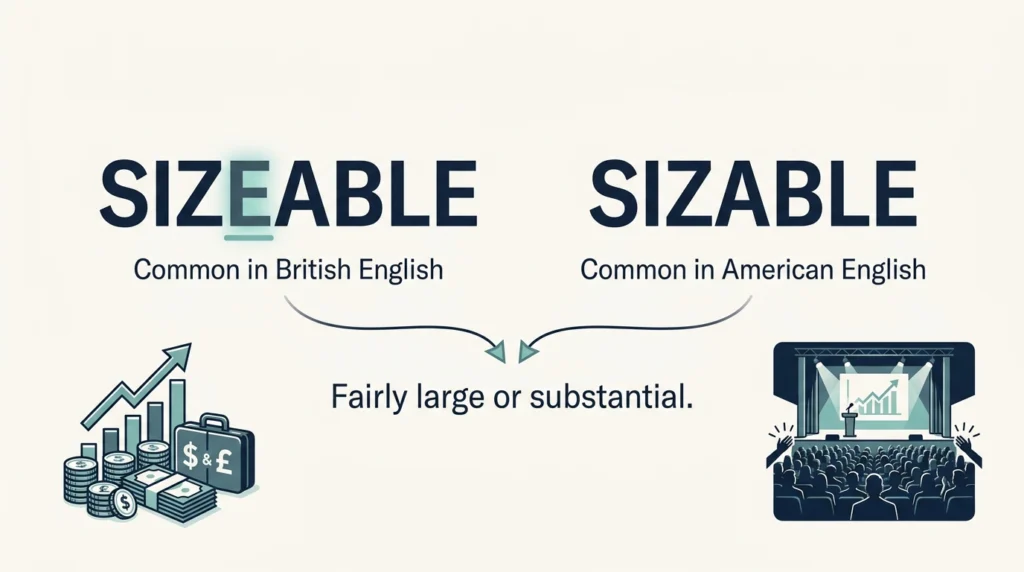

Both sizeable and sizable are correct English spellings. They have the same meaning: fairly large, considerable, or substantial in size or amount. The main difference is regional spelling preference: sizeable is especially common in British English, while sizable is especially common in American English. Neither spelling is inherently incorrect, and neither changes the meaning of a sentence. Choose the form that suits your intended variety of English, and use it consistently throughout your writing.
What Sizeable or Sizable Means
Both sizeable and sizable are adjectives used to describe something that is fairly large or substantial. The word can refer to physical dimensions, quantities, financial amounts, groups of people, differences, or the scale of an opportunity.
For example:
- The university received a sizeable donation to renovate its library.
- The company made a sizable investment in renewable energy.
- A sizeable proportion of the students preferred online classes.
- The delay caused a sizeable difference in the project’s final cost.
In each sentence, the adjective communicates that something is large enough to be noteworthy or significant.
Both spellings are standard English. The choice between them is primarily a matter of spelling convention, not meaning, grammar, or formality.
The Main Difference

The difference is the extra letter e in sizeable.
sizeable
Common in British English
The company secured a sizeable contract with a regional supplier.
sizable
Common in American English
The company secured a sizable contract with a regional supplier.
The sentences mean exactly the same thing. Both forms are understood internationally, and sizeable is also accepted in American English. The difference is a preference rather than a strict geographical restriction.
The spelling choice does not change the word’s pronunciation, grammatical role, or intended meaning.
Also Read: Taze or Tase: Which Spelling Is Correct?
The Core Rule
The Rule in Simple English
Use sizeable when following British English spelling conventions and sizable when following the usual American English preference.
If your publication, employer, university, or client specifies a spelling style, follow that style. If no style is specified, choose either accepted form and remain consistent.
Why the Rule Works
English contains many words with accepted spelling variants. Some differ according to regional conventions, while others have multiple spellings within the same variety of English.
Sizeable retains the e before the suffix -able, whereas sizable omits it. This is a spelling variation, not a difference in how the adjective is formed grammatically.
Compare these two expressions:
- A sizeable audience attended the lecture.
- A sizable audience attended the lecture.
Both are correct. The adjective modifies audience in exactly the same way.
It is also important not to assume that American English always removes a final e before a suffix or that British English always retains it. English spelling has exceptions, and individual words need to be checked when the correct form is uncertain.
How to Use It
Common Usage
Both spellings work in the same grammatical positions and contexts.
Before a noun
- The organisation operates in a sizeable market.
- The startup attracted a sizable customer base.
After a linking verb
- The financial risk is sizeable.
- The difference between the estimates was sizable.
With quantities and proportions
- We need a sizeable amount of storage space.
- A sizable percentage of applicants met the requirements.
In business and professional writing
- The proposal requires a sizeable budget.
- The department achieved a sizable reduction in processing time.
The adjective is especially useful when large sounds too general and you want to convey that the scale or amount is noteworthy. However, it does not specify an exact measurement. What counts as sizeable depends on the context.
Less Common or Special Usage
Both forms can describe physical size or abstract significance, but they do not necessarily mean enormous.
For example, a sizeable increase in monthly expenses could be substantial without being extraordinary. Similarly, a sizeable room may be spacious relative to an ordinary room without being exceptionally large.
Choose a more precise adjective when the degree matters:
- A 12% increase gives a measurable figure.
- A sizeable increase gives a qualitative assessment.
- A dramatic increase suggests a particularly striking change.
These expressions are not interchangeable in every context because they communicate different levels of precision or emphasis.
Correct Examples
The following examples show how both spellings work across everyday, academic, financial, and professional contexts.
- The charity received a sizeable donation from a local business.
- Our team spent a sizable amount of time testing the new software.
- The apartment has a sizeable balcony overlooking the garden.
- A sizable proportion of respondents supported the proposal.
- The university plans to make a sizeable investment in research facilities.
- The supplier offered a sizeable discount on bulk orders.
- There is a sizable gap between the projected and actual costs.
- The village attracts a sizeable number of visitors during the festival.
- The committee identified a sizeable risk in the original plan.
- The project requires a sizeable amount of storage space.
- The new policy produced a sizable improvement in response times.
- A sizeable audience stayed until the end of the presentation.
Every example remains correct if sizeable and sizable are exchanged. The best choice depends on the spelling convention you are following.
Incorrect vs Correct
Because both target spellings are valid, it would be misleading to label one of them incorrect. The genuine errors involve misspelling the word or confusing spelling preference with correctness.
| Incorrect or misleading | Correct form | Why |
|---|---|---|
| sizeble | sizeable / sizable | The spelling omits a required letter. |
| sizible | sizeable / sizable | The vowel pattern is incorrect. |
| sizeabble | sizeable / sizable | The word does not contain a doubled b. |
| sizeabel | sizeable / sizable | The letters are in the wrong order. |
| “Sizeable is always wrong in American English.” | Both spellings are accepted. | The difference is a preference, not an absolute restriction. |
| “Sizable is always wrong in British English.” | Both spellings are understood and accepted. | British English generally favours sizeable, but sizable is not inherently incorrect. |
| “Sizable is less formal than sizeable.” | Both can be used in formal writing. | The spelling difference does not determine formality. |
| “Sizeable means larger than sizable.” | Both have the same meaning. | There is no standard difference in degree. |
A spellchecker may flag one form if its language setting or dictionary prefers the other. That warning does not necessarily mean the word is misspelled.
Also Read: Carolling or Caroling: Which Spelling Is Correct?
Why People Make This Mistake
Several factors explain why writers hesitate between sizeable and sizable.
1. Only one letter separates them. The words look almost identical, so writers may assume that one must be an error.
2. Both spellings appear in reputable English writing. Exposure to American and British publications can make it difficult to determine which form to use in a particular document.
3. Spellcheckers follow selected language conventions. A document configured for American English may flag sizeable, while a British English dictionary may prefer it over sizable.
4. English suffix spelling is not completely predictable. Writers may try to apply a universal rule about retaining or removing the final e, even though spelling patterns vary by word.
5. People confuse preference with correctness. A form can be less common in a particular region without being wrong.
The most useful distinction is therefore not right versus wrong, but accepted spelling versus preferred spelling for your audience.
Common Mistakes
Mistake 1: Treating One Spelling as Universally Correct
Both sizeable and sizable are legitimate English words. Choosing one does not make the other incorrect.
Better approach: Check the conventions required for your audience rather than relying on a blanket spelling rule.
Mistake 2: Assuming the Forms Have Different Meanings
There is no standard semantic distinction between the two spellings.
Incorrect assumption: A sizeable profit is larger than a sizable profit.
Correct understanding: Both expressions describe a fairly large or substantial profit.
Mistake 3: Mixing Spellings Without a Reason
Using both forms in the same report can make the document look inconsistently edited, even though neither form is wrong.
Better approach: Select a preferred spelling before editing the document and apply it consistently.
Mistake 4: Assuming the Extra E Makes the Word More Formal
The extra letter does not make sizeable more professional, academic, or sophisticated.
Better approach: Choose the spelling that matches your style guide. Focus on whether the word accurately conveys the intended degree or amount.
Sizeable or Sizable in Real English
In real English, both spellings are natural and acceptable. The most suitable choice depends on the conventions of the publication or audience.
- Correct: Both spellings are valid.
- Natural: Both sound normal in sentences such as “a sizeable investment” and “a sizable investment.”
- Preferred by convention: Sizeable is commonly associated with British English; sizable is commonly associated with American English.
- Incorrect: Forms such as sizeble and sizible are misspellings.
Neither spelling is inherently more intelligent, formal, precise, or professional.
For international communication, readers will generally understand either form. Nevertheless, a consistent spelling style helps a document look carefully edited and avoids unnecessary corrections from automated tools.
American vs British English
Regional preference is the most useful distinction between these spellings.
| English variety | Usual preference | Example |
|---|---|---|
| American English | Sizable | The firm made a sizable investment. |
| British English | Sizeable | The firm made a sizeable investment. |
| International English | Either, consistently | The project attracted a sizeable audience. |
These are preferences, not rigid rules. Sizeable also appears in American English, and sizable is recognisable in British English.
If you are writing for a specific country, follow the spelling conventions of that audience. If you are editing an existing document, preserve its established style unless you have a reason to change it.
Comparison Table
| Feature | Sizeable | Sizable |
|---|---|---|
| Correct spelling | Yes | Yes |
| Part of speech | Adjective | Adjective |
| Meaning | Fairly large; substantial | Fairly large; substantial |
| Regional association | Common in British English | Common in American English |
| Pronunciation | Same | Same |
| Grammatical use | Modifies nouns or follows linking verbs | Modifies nouns or follows linking verbs |
| Formal writing | Acceptable | Acceptable |
| Meaningful difference in degree | None | None |
| Example | A sizeable investment | A sizable investment |
Memory Trick

Use this simple reminder:
British style: sizeable. American style: sizable.
Think of the extra e in sizeable as a visual cue for the British spelling preference. Remember that it is a memory aid, not an infallible rule for all English words.
If you forget which version to use, ask yourself two questions:
- Which English spelling style am I following?
- Have I used the same spelling throughout the document?
If you can answer both, you can make the choice confidently.
Real-Life Examples
At Work
British-style report:
“The department made a sizeable improvement in its annual performance.”
American-style report:
“The department made a sizable improvement in its annual performance.”
Both sentences are correct. The choice should match the organisation’s editorial conventions.
In an Email
British-style email:
Hi Alex,
I’ve reviewed the revised proposal. It requires a sizeable increase in the project budget, so we should discuss the additional funding before approving it.
Best regards
American-style email:
Hi Alex,
I’ve reviewed the revised proposal. It requires a sizable increase in the project budget, so we should discuss the additional funding before approving it.
Best regards
The only spelling difference is sizeable versus sizable. Both emails are equally professional.
Also Read: Hustle or Hussle: Which Spelling Is Correct?
At School or University
A student following British English conventions might write:
“The study found a sizeable difference between the two groups.”
A student following American English conventions might write:
“The study found a sizable difference between the two groups.”
In either case, the adjective describes the magnitude of the difference without specifying an exact numerical value. If the study provides a measurable difference, including the actual figure may improve precision.
In Everyday Conversation
- “That’s a sizeable bag to carry on the train.”
- “We saved a sizable amount by booking early.”
Both sentences are natural. The spelling difference is not a difference in spoken English.
Expert Tips
- Follow your audience. Use sizeable for the usual British English preference and sizable for the usual American English preference.
- Follow the house style. If a publisher, client, or employer specifies a dictionary or style guide, follow it.
- Be consistent, not rigid. Consistency improves editing quality, but encountering the alternative spelling does not automatically mean an error has occurred.
- Check the word, not just the suffix. Do not assume that every English word follows the same rule about retaining a final e.
- Use a precise measurement when possible. If a report says an expense rose by 18%, that figure is more informative than calling the increase sizeable.
- Do not confuse size with importance. Sizeable and sizable usually describe substantial scale or amount. They can imply significance, but they do not automatically mean important in every context.
- Review spellchecker settings. Confirm that the selected English variety matches the document before accepting spelling corrections.
Quick Summary
Sizeable and sizable are both correct spellings of the same adjective. They describe something fairly large, substantial, or considerable, whether it is a financial amount, a group, a physical space, a difference, or an increase. The extra e in sizeable does not change the word’s meaning, pronunciation, grammatical role, or level of formality. The main distinction is regional preference: sizeable is commonly used in British English, while sizable is commonly used in American English. Neither spelling is universally wrong, and both are understood internationally. For confident writing, follow your audience’s spelling conventions or the relevant style guide, and use one form consistently throughout the document.
Frequently Asked Questions
Is sizeable correct?
Yes. Sizeable is a standard English spelling, particularly common in British English. It means fairly large or substantial.
Is sizable correct?
Yes. Sizable is a standard spelling, especially associated with American English. It has the same meaning as sizeable.
Which is correct: sizeable or sizable?
Both are correct. Choose sizeable when following the usual British English preference and sizable when following the usual American English preference.
Is sizeable British or American English?
Sizeable is especially common in British English. However, it is also accepted in American English, so it should not automatically be treated as a British-only spelling.
Is sizable American or British English?
Sizable is especially common in American English. It is also recognised in British English, where sizeable is generally the more familiar regional preference.
Do sizeable and sizable mean the same thing?
Yes. Both mean fairly large, considerable, or substantial. There is no standard difference in meaning or degree.
Are sizeable and sizable pronounced differently?
No. They are normally pronounced the same way, approximately SY-zuh-buhl. The additional e in sizeable does not create a separate spoken form.
Which spelling should I use in formal writing?
Either spelling is suitable for formal writing. Follow the spelling convention of your audience or the style guide used by your organisation, university, or publisher.
Is sizeable more formal than sizable?
No. The extra letter does not make the word more formal. The two spellings have the same meaning and can be used in comparable professional and academic contexts.
Can I use both spellings in the same document?
You can, but it is usually better to select one spelling and apply it consistently. Mixing variants without a reason can make the document appear inconsistently edited.
Does sizeable mean enormous?
Not necessarily. Both words generally mean fairly large or substantial. Something sizeable is noteworthy in scale, but it does not have to be enormous.
What is the opposite of sizeable or sizable?
Depending on the context, useful opposites include small, minor, limited, modest, and insignificant. For example, a sizeable increase contrasts with a small increase, while a sizeable contribution contrasts with a minor contribution.
Mini Quiz
Choose the best answer for each question. The quiz tests spelling, meaning, grammar, and practical usage.
| # | Question | Answer | Explanation |
|---|---|---|---|
| 1 | Which spelling is valid: sizeable or sizable? | Both | Both are accepted English spellings. |
| 2 | Which spelling is commonly preferred in American English? | Sizable | The shorter form is especially common in American English. |
| 3 | Which spelling is commonly preferred in British English? | Sizeable | The form with the extra e is especially common in British English. |
| 4 | Fill in the blank: The charity received a ___ donation. (sizeble / sizeable) | Sizeable | Sizeable is correctly spelled; sizeble is not. |
| 5 | True or false: Sizable is always incorrect in British English. | False | It is a valid spelling, although sizeable is the usual British preference. |
| 6 | Do the two spellings have different meanings? | No | Both describe something fairly large or substantial. |
| 7 | Fill in the blank: The company made a ___ investment. (sizable / sizible) | Sizable | Sizable is correctly spelled; sizible is not. |
| 8 | Which form is more formal: sizeable or sizable? | Neither | Formality does not depend on this spelling variation. |
| 9 | A document consistently follows British English. Which spelling is the usual choice? | Sizeable | This matches the common British English preference. |
| 10 | A report needs to state the exact amount of an increase. Which is more precise: “a sizeable increase” or “an 18% increase”? | An 18% increase | A numerical figure specifies the amount; sizeable is qualitative. |
See Also: Senora or Senorita: Meaning, Difference & Correct Usage