
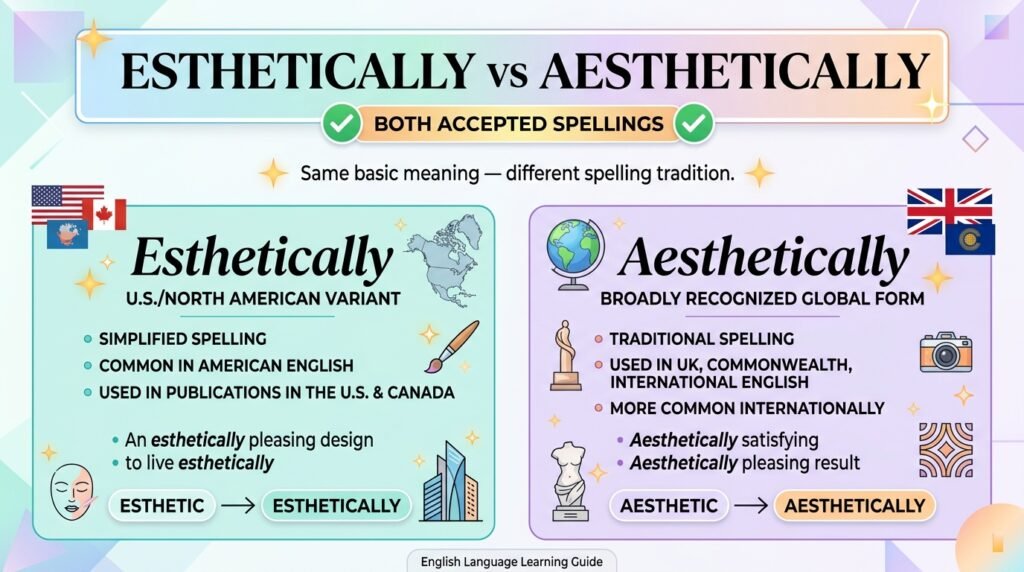

Both esthetically and aesthetically are correct English spellings of the same adverb. The main difference is spelling, not meaning. Aesthetically is the standard form used broadly in English, while esthetically is recognized as a U.S. or North American spelling variant. Both can describe something in relation to beauty, artistic quality, or aesthetics. If you want a form that works naturally for an international audience, aesthetically is the safest general choice.
What Esthetically or Aesthetically Means
Aesthetically and esthetically mean “in a way related to beauty, artistic appearance, or aesthetic qualities.” They are adverbs formed from aesthetic/esthetic.
For example:
- The room is aesthetically pleasing.
- The room is esthetically pleasing.
Both sentences communicate the same basic idea: the room looks attractive or has an appealing visual or artistic quality.
Cambridge lists esthetically as the U.S. spelling of aesthetically, while Oxford describes esthetically as a North American English variant.
The word can be used for more than physical beauty. It can describe the artistic or sensory qualities of a building, website, painting, film, product, room, photograph, design, or other experience.
For example, someone might say that a film is aesthetically interesting even if they are not simply saying that it looks “pretty.” They may be discussing its visual style, artistic choices, composition, or overall aesthetic character.
So the basic meaning is:
Aesthetically/esthetically = in a way connected with beauty, artistic appearance, or aesthetic principles.
SEE READ: Sells OR Sales: Meaning, Difference, Grammar & Correct Usage
The Main Difference
The main difference between esthetically and aesthetically is the spelling.
| Form | Status | Main difference |
|---|---|---|
| aesthetically | Correct | Standard spelling used broadly |
| esthetically | Correct | U.S./North American spelling variant |
There is no meaningful difference in basic meaning between the two forms.
The difference comes from the related words aesthetic and esthetic. The shorter esthetic spelling removes the initial a, and the corresponding adverb becomes esthetically.
This means you should not treat esthetically as a misspelling simply because it looks unusual compared with aesthetically. It is an established English spelling. Cambridge explicitly identifies it as a U.S. spelling, and Oxford identifies it as a North American form.
The safest distinction is therefore:
aesthetically = standard, broadly usable spelling
esthetically = accepted North American/U.S. variant
If you are writing for an international audience and have no reason to follow a particular American spelling convention, aesthetically is usually the clearer choice because it preserves the familiar spelling of aesthetic.
The Core Rule
The Rule in Simple English
When you mean “in a way related to beauty or aesthetics,” use either:
aesthetically
or
esthetically
Both are legitimate.
However, if you need one spelling for general international writing, use aesthetically.
The same spelling relationship appears in related words:
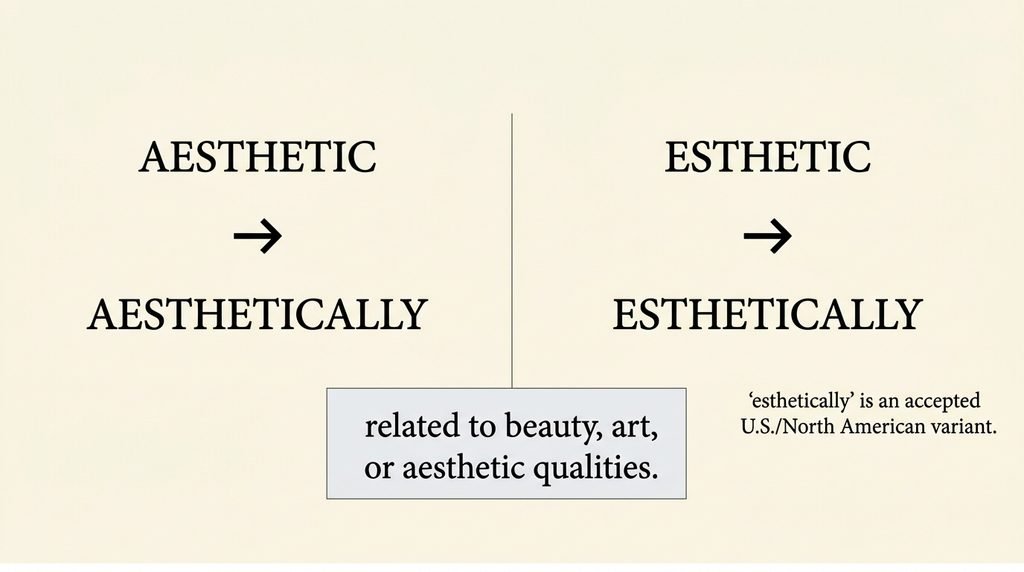
- aesthetic → aesthetically
- esthetic → esthetically
The shortened esthetic family is particularly associated with American/North American usage.

Why the Rule Works
English has retained different spelling traditions for this word family.
The longer form uses aesthetic, producing aesthetically. The shorter form uses esthetic, producing esthetically.
This is not a case where one spelling suddenly changes the grammatical function or meaning. Both forms are adverbs.
For example:
- The designer considered the colors aesthetically.
- The designer considered the colors esthetically.
The underlying meaning remains the same.
The important lesson is that spelling variation does not automatically mean meaning variation. Sometimes English has two established forms that coexist, and this is one of those cases.
How to Use It
Common Usage
Aesthetically is commonly used when discussing the appearance, design, artistic character, or aesthetic qualities of something.
It frequently appears with words such as:
- aesthetically pleasing
- aesthetically appealing
- aesthetically beautiful
- aesthetically interesting
- aesthetically satisfying
- aesthetically balanced
- aesthetically attractive
- aesthetically designed
The expression aesthetically pleasing is especially common. Cambridge also recognizes esthetically pleasing as the U.S. variant.
For example:
The new website is simple and aesthetically pleasing.
Here, aesthetically describes the quality of the website’s appearance and design.
The word can also be used when discussing artistic judgment:
The two paintings are very different aesthetically.
In this sentence, aesthetically means that the paintings differ in their artistic or aesthetic qualities.
Esthetically works in the same kinds of sentences:
The new website is simple and esthetically pleasing.
The meaning is unchanged.
Less Common or Special Usage
You may encounter esthetically in American publications, technical writing, design discussions, and other contexts where the esthetic spelling is used.
For example:
The product was designed to be both functional and esthetically appealing.
There is nothing grammatically wrong with this sentence.
You should also understand that aesthetically does not always mean simply “beautiful.”
Consider:
The film is aesthetically unusual.
This does not necessarily mean the film is beautiful. It means its artistic or aesthetic qualities are unusual.
Likewise:
The building is aesthetically different from the surrounding architecture.
This describes its aesthetic character, not necessarily its quality.
Correct Examples
- The new website is aesthetically pleasing and easy to navigate.
- The designer wanted the packaging to be both practical and aesthetically appealing.
- The two paintings are completely different aesthetically.
- The furniture is simple but aesthetically attractive.
- The architect arranged the windows aesthetically as well as functionally.
- The updated logo looks more balanced aesthetically.
- The filmmaker made several aesthetically bold choices.
- The garden was carefully arranged to look aesthetically balanced.
- The product is functional but also esthetically pleasing.
- The designer considered the room esthetically successful.
- The new interface is more aesthetically consistent than the previous version.
- The sculpture may be controversial, but it is certainly interesting aesthetically.
These examples show an important point: the two spellings can perform the same grammatical job and express the same general meaning.
Incorrect vs Correct
Because esthetically is a legitimate spelling, it should not be placed in an “incorrect” column simply because aesthetically is more familiar to many readers.
The genuine spelling mistakes are forms that incorrectly alter the word’s structure.
| ❌ Incorrect | ✅ Correct | Why |
|---|---|---|
| aesthetcially | aesthetically | The letters are in the wrong order. |
| aestheticly | aesthetically | The standard adverb ending requires -ally here. |
| estheticly | esthetically | The correct form is esthetic + -ally. |
| aestheically | aesthetically | The t is missing. |
| aesthically | aesthetically | The spelling is incomplete. |
| estheically | esthetically | The spelling is missing the t and does not form the standard adverb. |
| aesthetikally | aesthetically | The spelling incorrectly substitutes k for c. |
| aestheticallly | aesthetically | There is an extra l. |
| esthetcally | esthetically | The letters are incorrectly arranged. |
| aestheticallyy | aesthetically | There is an unnecessary extra y. |
Notice that esthetically itself does not belong in the incorrect column. It is an accepted spelling variant. Cambridge specifically identifies it as the U.S. spelling of aesthetically.
Why People Make This Mistake
The confusion happens because the word has two established spelling patterns:
aesthetic → aesthetically
and
esthetic → esthetically
The first pattern is visually longer and retains the initial a. The second removes that a.
For someone who has mostly seen aesthetic, the spelling esthetically can look like a typo. Conversely, someone familiar with American esthetic may wonder why another writer uses the longer aesthetic form.
Another source of confusion is pronunciation.
The initial a in aesthetic can make learners unsure whether it belongs in the written word. English also contains other words with variable or unusual spellings, so learners may not immediately recognize that esthetic and aesthetic belong to the same word family.
The important thing is not to memorize esthetically as an error. Instead, recognize it as the adverb corresponding to the accepted variant esthetic.
Common Mistakes
Mistake 1: Assuming Esthetically Is Always Wrong
A common error is correcting every instance of esthetically to aesthetically.
That correction is not always necessary.
Esthetically is a legitimate U.S./North American spelling variant.
So:
The design is esthetically pleasing.
is not automatically wrong.
Mistake 2: Treating the Two Forms as Different in Meaning
Another mistake is assuming that aesthetically means one kind of beauty while esthetically means another.
There is no standard meaning distinction like that.
The spelling changes; the basic meaning does not.
Mistake 3: Writing Aestheticly
Some learners see aesthetic and simply add -ly:
aesthetic + ly → aestheticly
But the standard form is:
aesthetic + ally → aesthetically
The same pattern is reflected in the spelling of the adjective and adverb.
Mistake 4: Thinking American English Always Requires Esthetically
American English allows esthetically, but that does not mean American writers must use it.
Aesthetically is also used in American English. Dictionary sources list both forms in American usage.
Mistake 5: Assuming a Variant Is Less Grammatical
A spelling variant can be fully grammatical even if it is less familiar to a particular reader.
The question is not simply “Have I seen this spelling before?”
The better question is:
“Is this an established spelling of the word in the relevant English variety?”
For esthetically, the answer is yes.
Esthetically or Aesthetically in Real English
Real English usage shows that both forms are used, but they do not necessarily have equal distribution across all varieties of English.
Aesthetically is the broadly recognized form and appears in British English, international English, and American English. Esthetically is specifically identified by major dictionaries as a U.S. or North American variant.
This creates an important distinction between correctness and choice.
If you write:
The building is aesthetically pleasing.
you are using the broadly recognized form.
If you write:
The building is esthetically pleasing.
you are using an accepted North American variant.
Neither sentence changes the underlying idea.
For international websites, academic communication involving readers from different countries, or general English-learning material, aesthetically is a practical default because it keeps the familiar aesthetic spelling visible.
For an American publication that consistently uses esthetic and related forms, esthetically can fit naturally with that spelling system.
The choice can therefore depend on the style of English you are following rather than on grammar.
Formal vs Informal Usage
Formal Usage
Both forms can occur in formal writing because both are established spellings.
However, consistency matters more than trying to force one spelling into every situation.
If a formal document uses:
aesthetic
then aesthetically creates a consistent word family.
If a document consistently follows the esthetic spelling, esthetically can also be appropriate.
For international readers, aesthetically is generally the less surprising spelling because it is the form most readers will recognize from the base word aesthetic.
Everyday Usage
In everyday writing, either form may be understood without difficulty.
For example:
The room is aesthetically pleasing.
or:
The room is esthetically pleasing.
Both communicate the same idea.
In casual communication, the more important issue is usually not which variant you choose but whether you use the word naturally in context.
Comparison Table
| Feature | Aesthetically | Esthetically |
|---|---|---|
| Basic meaning | Related to beauty, art, or aesthetics | Same |
| Part of speech | Adverb | Adverb |
| Base form | aesthetic | esthetic |
| Spelling | Longer form with ae | Shorter form without initial a |
| Main role | Describes an aesthetic manner or quality | Same |
| English variety | Broadly used | U.S./North American variant |
| Meaning difference | None in standard usage | None in standard usage |
| Example | aesthetically pleasing | esthetically pleasing |
| International readability | Broadly recognizable | More regionally marked |
| Is it correct? | Yes | Yes |
Memory Trick
Use this simple connection:
AESTHETIC → AESTHETICALLY
If you already know the standard spelling aesthetic, simply keep the a when forming the adverb:
aesthetic → aesthetically
Then remember:
ESTHETIC → ESTHETICALLY
If you see the shorter esthetic, its matching adverb is:
esthetic → esthetically
An easy way to remember the relationship is:
Same family, different spelling tradition.
Do not memorize esthetically = wrong.
Instead, memorize:
Aesthetically = broad standard form
Esthetically = accepted North American variant
Real-Life Examples
At Work
Design and product discussions often require language about appearance and usability.
The new dashboard is aesthetically cleaner than the previous version.
The packaging is both functional and aesthetically appealing.
If an American team uses esthetic terminology consistently, you may also see:
The new packaging is esthetically appealing.
The spelling does not change the design requirement or meaning.
In an Email
A designer or manager might write:
I like the new layout because it is aesthetically balanced without sacrificing readability.
Or:
The revised presentation looks more aesthetically consistent.
Here, aesthetically describes the visual quality of the design.
In Conversation
Someone might say:
I like this café. It’s aesthetically beautiful.
A more natural conversational alternative could simply be:
I really like how this café looks.
This illustrates another important point: a word can be correct without being the only natural way to express an idea.
Aesthetically is perfectly valid, but ordinary conversation often uses simpler expressions such as “looks good,” “looks beautiful,” or “has a nice design.”
At School or University
In an essay about art, architecture, film, or design, you might write:
The building is aesthetically significant because its design combines traditional and modern elements.
Or:
The two films differ aesthetically even though they tell similar stories.
The word is especially useful when the discussion concerns artistic or aesthetic qualities rather than simple physical attractiveness.
Expert Tips
- Do not mark “esthetically” as automatically wrong. It is an established spelling variant.
- Use “aesthetically” when you want the broadly familiar form. It matches the spelling of aesthetic.
- Use “esthetically” when following a North American spelling style that uses “esthetic.”
- Keep the word family consistent. If you write esthetic, then esthetically follows naturally.
- Do not invent a meaning difference. The two adverbs do not normally express different types of beauty.
- Remember that “aesthetically” can describe artistic character, not just visual beauty. A film can be aesthetically unusual, a design can be aesthetically coherent, and two artworks can differ aesthetically.
- Do not confuse correctness with personal familiarity. A spelling that looks unusual to you may still be legitimate English.
- For international content, consistency is more important than trying to create a false distinction between the variants.
- Learn the base words too. Understanding aesthetic and esthetic makes the adverbial forms much easier to remember.
- Check the style of the publication when consistency matters. A document that follows one spelling system should normally maintain that system throughout.
Quick Summary
Esthetically and aesthetically are both correct English adverbs with the same basic meaning: they describe something in relation to beauty, artistic quality, or aesthetics. The main difference is spelling and regional preference, not grammar or meaning. Aesthetically is the broadly recognized form, while esthetically is identified by major dictionaries as a U.S./North American spelling variant. If you are writing for an international audience, aesthetically is a straightforward default. If you are following American/North American usage that uses esthetic, esthetically is also correct. Most importantly, do not treat esthetically as a spelling mistake.
Frequently Asked Questions
Is “esthetically” correct?
Yes. Esthetically is a correct and established spelling. Cambridge identifies it as the U.S. spelling of aesthetically, and Oxford lists it as a North American English variant.
Is “aesthetically” correct?
Yes. Aesthetically is the standard spelling broadly recognized in English. It means in a way related to beauty, art, or aesthetics.
Is there a difference between esthetically and aesthetically?
The main difference is spelling. The two forms have the same basic meaning and grammatical function.
Is esthetically American English?
It is particularly associated with U.S./North American English. Cambridge labels it as a U.S. spelling, while Oxford describes it as North American English.
Should I use aesthetically or esthetically?
For general or international English, aesthetically is a practical default. If you are following a North American spelling style that uses esthetic, esthetically is also appropriate.
Is “aesthetically pleasing” correct?
Yes. Aesthetically pleasing is a common expression meaning enjoyable or attractive from an aesthetic point of view. Cambridge also recognizes esthetically pleasing as the U.S. variant.
Is “esthetically pleasing” correct?
Yes. Esthetically pleasing is a legitimate variant of aesthetically pleasing, particularly in U.S. usage.
Does esthetically mean something different from aesthetically?
No standard meaning difference exists between them. Both describe something in relation to aesthetic qualities.
Is “aestheticly” correct?
No. The standard spelling is aesthetically, not aestheticly.
Is “estheticly” correct?
No. If you use the shorter base spelling esthetic, the corresponding adverb is esthetically.
Which spelling is better for international English?
Aesthetically is the practical choice for broad international readability because it retains the familiar spelling aesthetic.
Can I use both spellings in the same article?
You can, but consistency is usually better. If there is no reason to switch spelling systems, choose one form and use it consistently.
Mini Quiz
| # | Question | Answer | Explanation |
|---|---|---|---|
| 1 | Which spelling is the broadly recognized form: aesthetically or aestheticly? | aesthetically | The correct adverb is formed as aesthetically. |
| 2 | Is esthetically a valid English spelling? | Yes | It is an established U.S./North American variant. |
| 3 | Fill in the blank: The room is ______ pleasing. | aesthetically | Aesthetically pleasing is a standard expression. |
| 4 | Is aestheticly correct? | No | The standard spelling is aesthetically. |
| 5 | Does esthetically have a completely different meaning from aesthetically? | No | The two forms have the same basic meaning. |
| 6 | Which base word corresponds to esthetically: esthetic or aesthetic? | esthetic | Esthetically is formed from the shorter esthetic spelling. |
| 7 | Which form is identified by Cambridge as a U.S. spelling: esthetically or aesthetically? | esthetically | Cambridge identifies esthetically as the U.S. spelling of aesthetically. |
| 8 | Choose the correct spelling: “The website was ______ designed.” | aesthetically | Aesthetically is the standard broad form. |
| 9 | Is this sentence acceptable? “The product is esthetically pleasing.” | Yes | Esthetically pleasing is an accepted variant. |
| 10 | If you are writing for a broad international audience, which form is a practical default? | aesthetically | It is the broadly recognized spelling and matches aesthetic. |