
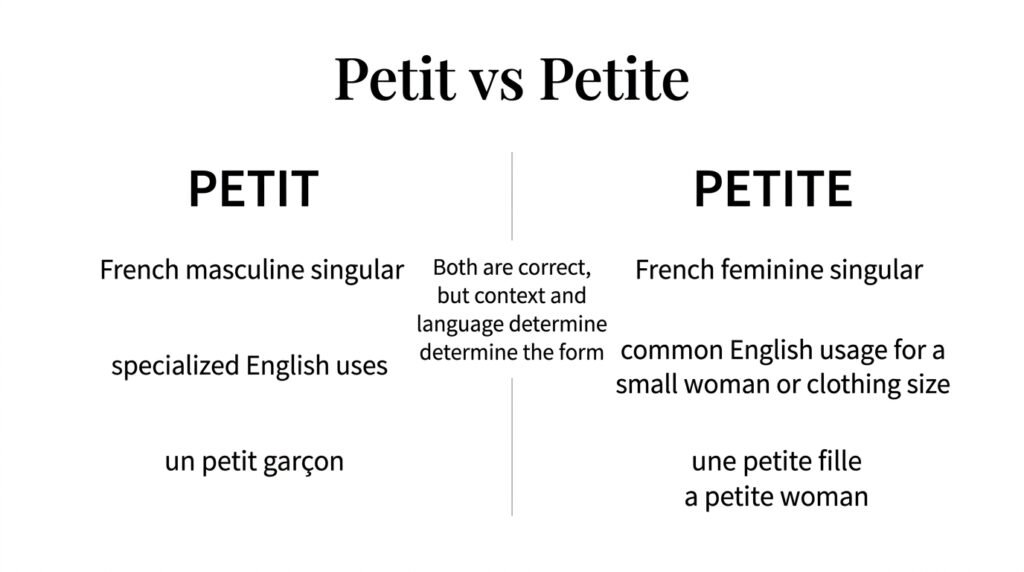

If you are asking which form to use, petit and petite are both correct, but they do not work the same way in every context. In French, petit is the masculine singular form and petite is the feminine singular form of the adjective meaning “small” or “little.” In English, however, petite has become a commonly used adjective for a woman or girl who is small in stature, while petit has much more limited English usage, especially in legal terms and established French expressions.
What petit or petite Means
The easiest way to understand petit vs. petite is to separate French grammar from English usage.
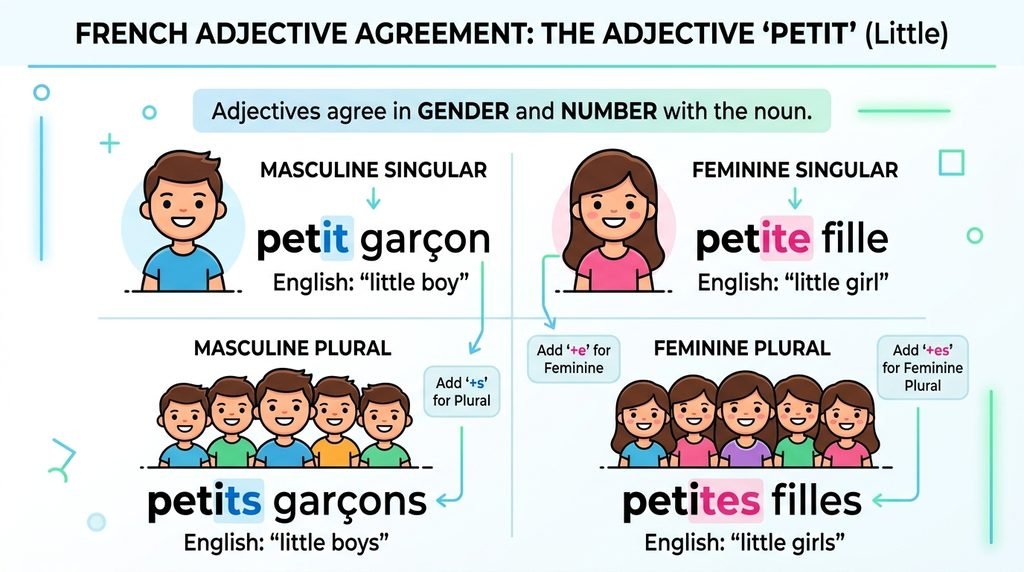
In French, petit means “small,” “little,” or sometimes “young,” and the adjective changes according to the gender and number of the noun it describes. Petit is masculine singular, while petite is feminine singular. For example, un petit garçon means “a little boy,” while une petite fille means “a little girl.”
French also has plural forms: petits for masculine plural and petites for feminine plural.
English borrowed petite from French, but English does not use it simply as the feminine version of petit. In modern English, petite is an established English adjective meaning small in stature, especially when describing a woman or girl. It can also be a noun referring to a clothing size for shorter women.
By contrast, petit has a much narrower role in ordinary English. English dictionaries recognize petit particularly in legal language, where it can mean small, minor, or of lesser importance, as in petit jury. It also appears in established French-derived expressions such as petit four and petit bourgeois.
So, if your question is simply “Should I write petit or petite when describing a small woman?”, the natural English choice is petite.
The Main Difference
The central difference depends on which language you are using and what you are trying to say.
| Form | Main role | Example |
|---|---|---|
| petit | Masculine singular French adjective; limited English uses | un petit garçon |
| petite | Feminine singular French adjective; established English adjective | une petite fille / a petite woman |
In French
French uses grammatical gender:
- un petit garçon = a little boy
- une petite fille = a little girl
- un petit appartement = a small apartment
- une petite maison = a small house
The change from petit to petite is grammatical. It is not simply a spelling preference.
In English
English normally does not change adjectives according to whether a noun is masculine or feminine.
You would say:
- a small boy
- a small girl
- a small house
- a small apartment
But petite has entered English as a special borrowed word. It is commonly used to describe a woman or girl who is small in stature, and it is also used in clothing terminology.
That is why you should not assume that English simply follows French and uses petit for males and petite for females.
The Core Rule
The Rule in Simple English
Use petit and petite according to French grammar when you are writing in French.
- petit = masculine singular
- petite = feminine singular
- petits = masculine plural
- petites = feminine plural
When writing ordinary English, petite is the normal word when describing a woman or girl as small in stature.
SEE ALSO: Turnstyle or Turnstile: Correct Spelling and Meaning
For example:
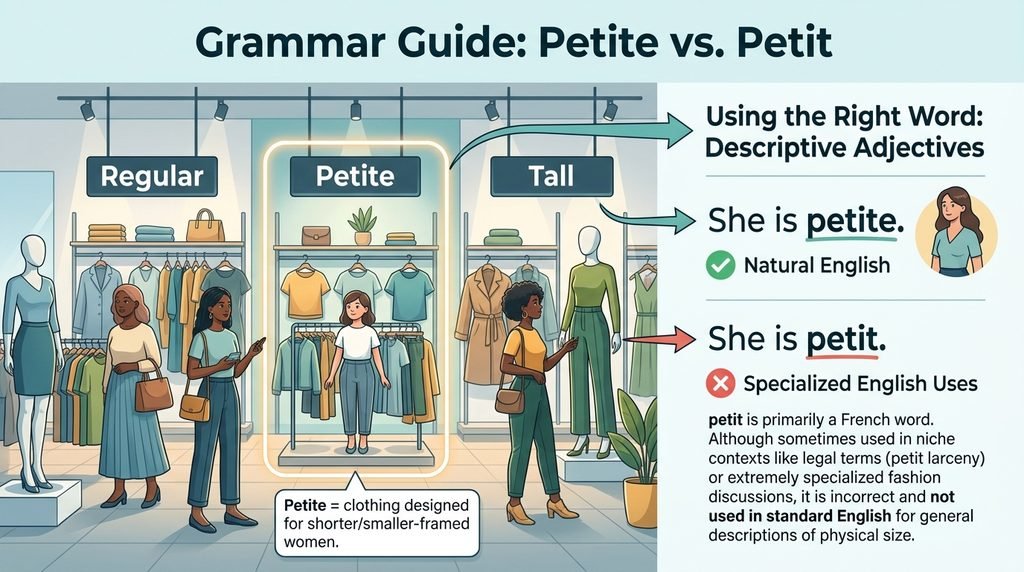
She is petite.
That is natural English.
You would not normally write:
She is petit.
if your intended meaning is simply that she is a small woman.
Why the Rule Works
The two words have different histories in English.
French treats petite as the feminine form of petit. English borrowed petite and developed its own established meaning and usage. Modern English dictionaries define petite as an adjective used especially for a woman or girl who is small or short in stature; they also recognize petite as a clothing-size term.
English also has petit, but its ordinary English meaning is much narrower. In legal contexts, petit can mean small, minor, or lesser in importance, as in petit jury.
Therefore, treating petit and petite as interchangeable English spellings would create confusion.
How to Use It
Common Usage
Petite is most commonly useful in English when talking about:
- a woman’s height or build
- a girl’s small stature
- clothing designed for shorter women
- a small or delicate figure
- certain established expressions borrowed from French
Examples:
- She is petite but very athletic.
- My sister has a petite frame.
- The store has a large petite section.
- She needs a petite jacket because the regular sleeves are too long.
English dictionaries specifically identify petite with small stature and clothing for women of shorter-than-average height.
Petit, on the other hand, is not the ordinary English replacement for small.
It can appear in specialized or established expressions, including legal terminology such as petit jury, and French-derived terms such as petit four.
Less Common or Special Usage
There are situations where petit is completely legitimate in English, so it would be inaccurate to say that petit is simply “wrong.”
For example:
- petit jury is a legal term.
- petit bourgeois is an established expression.
- petit four is an established culinary term.
- petit pois is a French-derived food term.
The important point is that these are specific established uses. You cannot take the French adjective petit and freely use it throughout an English sentence as though English grammar worked exactly like French grammar.
Correct Examples
Here are examples showing how the two forms work in different contexts.
- She is petite and has a delicate frame.
- The boutique specializes in petite clothing.
- My sister is petite, so regular trousers are often too long for her.
- The designer created a jacket for petite women.
- She chose a petite size instead of a regular size.
- He ordered a petit four with his coffee.
- The French sentence describes a petite maison, meaning a small house.
- The phrase “petit jury” belongs to legal English.
- Un petit garçon means “a little boy” in French.
- Une petite fille means “a little girl” in French.
- Un petit livre means “a small book” in French.
- Une petite voiture means “a small car” in French.
- The actress has a petite figure.
- This brand offers several styles in petite sizes.
- She is petite, but the regular-size dress fits her perfectly.
Notice that the correct form depends on whether the sentence is French or English and what meaning is intended.
SEE READ: Esthetically or Aesthetically: Which Spelling Is Correct?
Incorrect vs Correct
The following examples focus specifically on common learner confusion. Some uses of petit are legitimate in English, so the table does not label every occurrence of petit as incorrect.
| ❌ Incorrect or unnatural for the intended meaning | ✅ Correct | Why |
|---|---|---|
| She is petit. | She is petite. | Petite is the established English adjective for a small woman. |
| My sister is very petit. | My sister is very petite. | English uses petite for this meaning. |
| She bought a petit dress size. | She bought a petite dress size. | Petite is the English clothing-size term. |
| She has a petit frame. | She has a petite frame. | Petite frame is natural English. |
| The store has petit sizes for women. | The store has petite sizes for women. | The clothing category is called petite. |
| She is a petit woman. | She is a petite woman. | Petite is the normal English adjective here. |
| She chose petit clothing because she is short. | She chose petite clothing because she is short. | Petite is used for this clothing category. |
| She has a petit figure. | She has a petite figure. | Petite figure is an established English phrase. |
| Petit is always wrong in English. | Petit has specialized English uses. | Petit occurs in legal terminology and established expressions. |
| Petite is always the feminine form of every English adjective. | Petite is a special borrowed English word. | English does not generally mark adjective gender. |
The last two points are especially important. Petite is not simply an English adjective ending that you add whenever a woman is involved. It is a borrowed word with its own established meaning.
Why People Make This Mistake
The confusion is understandable because petit and petite come from the same French word family.
A learner may see:
petit = small
petite = small
and conclude that the difference is simply masculine versus feminine.
That conclusion is correct within French grammar, but it becomes misleading when applied directly to English.
French adjectives agree with nouns in grammatical gender and number. Therefore:
un petit garçon
and
une petite fille
are normal French constructions.
English normally does not do this. We do not change small to a different form when the noun is feminine.
The problem becomes more confusing because English has adopted petite as a standalone English word. English speakers can therefore use petite without speaking French at all.
For example:
She is petite.
is ordinary English.
The word’s French origin explains the spelling, but its modern English usage must be learned separately. Dictionaries identify petite as an English adjective and also as a noun related to clothing sizes.
Common Mistakes
Mistake 1: Assuming Petit Is the Male Version of Petite in English
A learner may think:
He is petit.
She is petite.
That is not the normal English pattern.
In French, grammatical gender does matter:
Il est petit.
Elle est petite.
But in ordinary English, petit is not simply the masculine equivalent of English petite.
If you want to say that a man is small or short, ordinary English normally uses words such as:
- small
- short
- slight
- slender
depending on the intended meaning.
Mistake 2: Thinking Petite Means Only “Short”
Petite usually describes more than height alone in traditional English usage. It commonly suggests a small, compact, or delicate build, especially when describing a woman or girl. Cambridge defines the English adjective in terms of being small and thin, while American dictionary definitions emphasize shorter-than-average height and a small build.
So:
She is short.
and:
She is petite.
are related, but they are not necessarily identical in tone or meaning.
Mistake 3: Calling Petit Completely Incorrect
This is an overcorrection.
Petit is a real English word in certain contexts. For example, petit jury is a recognized legal term. English also contains established French expressions using petit.
The better rule is:
Do not use petit as the ordinary English adjective for a small woman.
That is more accurate than saying:
Petit is never an English word.
Mistake 4: Treating French and English Grammar as Identical
A French sentence such as:
une petite maison
does not mean English must have a gendered adjective.
The correct English translation is simply:
a small house
English has lost the French adjective agreement system in ordinary usage.
petit or petite in Real English
The distinction becomes much clearer when you look at actual English usage.
Correct and Natural
She is petite.
This is natural English.
Correct and Natural
The store has a petite section.
This is natural clothing-related English.
Correct but Specialized
The case was heard by a petit jury.
Here, petit is part of legal terminology. It is not describing someone’s body size.
Correct as an Established Expression
We served petit fours after dinner.
Here, petit is part of a French-derived culinary expression.
Correct French, Not Ordinary English
Elle est petite.
This is correct French meaning “She is small/short.”
Correct French
Il est petit.
This is correct French meaning “He is small/short.”
The key is therefore context, not simply the number of letters at the end of the word.
Formal vs Informal Usage
Formal Usage
In English, petite is acceptable in professional, fashion, descriptive, and general written contexts.
For example:
The collection includes petite sizes.
or:
The garment was designed for petite customers.
In formal writing, however, it is often better to choose the word that expresses the exact intended meaning. If you simply mean that someone is short, short may be more precise than petite.
Everyday Usage
In everyday English, petite is common when describing a woman’s build or discussing clothing.
For example:
She’s quite petite.
or:
Do you have this in petite?
The second example is particularly associated with clothing.
ALSO READ: Sells OR Sales: Meaning, Difference, Grammar & Correct Usage
Comparison Table
| Feature | petit | petite |
|---|---|---|
| French masculine singular | Yes | No |
| French feminine singular | No | Yes |
| Basic French meaning | Small/little | Small/little |
| Ordinary English adjective for a small woman | No | Yes |
| English clothing term | Not normally | Yes |
| English legal usage | Yes, specialized | No |
| Can occur in French expressions | Yes | Yes |
| Main English pronunciation | Varies by usage | /pəˈtiːt/ |
| Main learner issue | Overusing it as English adjective | Assuming it is only a French feminine form |
| Example | petit jury | a petite woman |
Memory Trick
Use this simple two-part trick:
French → Check the noun
If you are writing French, ask:
Is the noun masculine or feminine?
- masculine singular → petit
- feminine singular → petite
Remember:
petit garçon
petite fille
English → Think “petite woman”
If you are writing ordinary English and describing a small woman or discussing women’s clothing, think:
petite
A useful memory sentence is:
A petite woman wears petite clothing.
This helps you connect the English adjective with its most recognizable modern usage.
Real-Life Examples
At Work
Sarah is petite, so the standard-size uniform sleeves are slightly long for her.
The company ordered petite, regular, and tall sizes for the new uniforms.
Here, petite refers to body proportions or clothing categories.
In an Email
Could you please confirm whether the jacket is available in a petite size?
This is a natural use of petite in professional communication.
In Conversation
My sister is pretty petite, so she usually shops in the petite section.
Here, petite describes someone’s small build.
At School or University
The French adjective changes from petit to petite when it agrees with a feminine singular noun.
This is a discussion about French grammar, so both forms can be relevant.
Expert Tips
- Do not treat petit and petite as interchangeable English spellings. They have different roles in modern English.
- Identify the language first. If the sentence is French, grammatical gender determines the adjective form.
- For ordinary English, use petite when describing a small woman or girl.
- Do not assume petite means exactly “short.” It can also suggest a small or delicate build.
- Use petite for clothing categories. Phrases such as petite size, petite clothing, and petite section are standard English uses.
- Do not call petit universally incorrect. It has recognized specialized English uses, especially in legal language.
- Do not translate French adjective agreement mechanically. French petite does not mean that English adjectives generally have feminine versions.
- Pay attention to meaning. If you simply mean “short,” short may be clearer than petite.
- Remember that English pronunciation can differ from French pronunciation. The English adjective petite is commonly pronounced /pəˈtiːt/.
- Learn common phrases instead of memorizing isolated spellings. Petite woman, petite figure, and petite size are more useful than memorizing the word alone.
Quick Summary
Petit and petite are related forms, but their usage depends heavily on whether you are writing French or English. In French, petit is masculine singular and petite is feminine singular, so the adjective agrees with the noun. In English, however, petite has developed into an established adjective commonly describing a woman or girl who is small in stature, and it is also used for clothing sizes. Petit remains a legitimate but much more specialized English word, particularly in legal terminology and established French expressions. Therefore, for ordinary English such as “She is small and slender,” petite is the natural choice—not petit.
Frequently Asked Questions
Is petit or petite correct?
Both can be correct, but the answer depends on the language and context. In French, petit is masculine singular and petite is feminine singular. In ordinary English, petite is the normal form for describing a woman who is small in stature.
Is petite the feminine form of petit?
Yes, in French. Petit is masculine singular and petite is feminine singular. However, in English, petite has become an independent borrowed word with its own established meaning.
Is “she is petit” correct English?
Not as ordinary English if you mean that the woman is small or short. The natural expression is:
She is petite.
Petit does have specialized English uses, but it is not the ordinary feminine/male counterpart system English speakers use for describing people.
Is “she is petite” correct?
Yes. She is petite is standard English. It generally describes a woman or girl who is small in stature, often suggesting a small or delicate build.
Can petit be used in English?
Yes. Petit is a recognized English word in specialized contexts. One important example is legal terminology such as petit jury, where it refers to something small or of lesser importance. It also appears in established French-derived expressions.
Is petite only used for women?
The traditional English usage is strongly associated with women or girls, particularly when referring to body size or clothing. Some modern uses can extend the word to things that are small, but describing a woman or clothing size remains the clearest and most established use.
What does petite mean in clothing?
In clothing, petite refers to a size category designed for women who are shorter than average, with proportions intended for smaller frames. It can also be used as a noun for that size category or a garment in that category.
What does petit mean in French?
In French, petit generally means “small” or “little.” It can also convey ideas such as young, minor, short, or slight depending on context. Its feminine singular form is petite.
What does petite mean in French?
In French, petite is the feminine singular form of petit. For example, une petite maison means “a small house.”
Should I use petit or petite for a small man?
In ordinary English, neither is normally the best choice simply because the person is male. Use a more precise English word such as short, small, slight, or slender, depending on what you actually mean. In French, however, petit is the masculine singular form.
How do I remember petit vs petite?
Remember two rules: French → check grammatical gender; English → “petite woman” and “petite size.” If you are describing a small woman in ordinary English, petite is the form you will normally want.
Mini Quiz
| # | Question | Answer | Explanation |
|---|---|---|---|
| 1 | Which is natural English: “She is petit” or “She is petite”? | She is petite. | Petite is the established English adjective for a small woman. |
| 2 | In French, which form describes a masculine singular noun? | petit | Petit is the masculine singular form. |
| 3 | In French, which form describes a feminine singular noun? | petite | Petite is the feminine singular form. |
| 4 | Choose the correct phrase: “a ___ size” | petite | Petite size is a standard English clothing term. |
| 5 | Is “petit jury” a valid English expression? | Yes | Petit jury is a specialized legal term. |
| 6 | Correct this sentence: “My sister is very petit.” | My sister is very petite. | Petite is the natural English adjective for this meaning. |
| 7 | What does French une petite maison mean? | a small house | Petite agrees with the feminine noun maison. |
| 8 | What does petite commonly mean when used in English about a woman? | Small in stature/build | English uses petite especially for a woman or girl who is small or short. |
| 9 | Is “petit” always incorrect in English? | No | It has specialized uses, including legal terminology and established expressions. |
| 10 | Which sentence is correct for ordinary English? A) “She is petit.” B) “She is petite.” | B) She is petite. | Petite is the standard choice when describing a small woman. |