
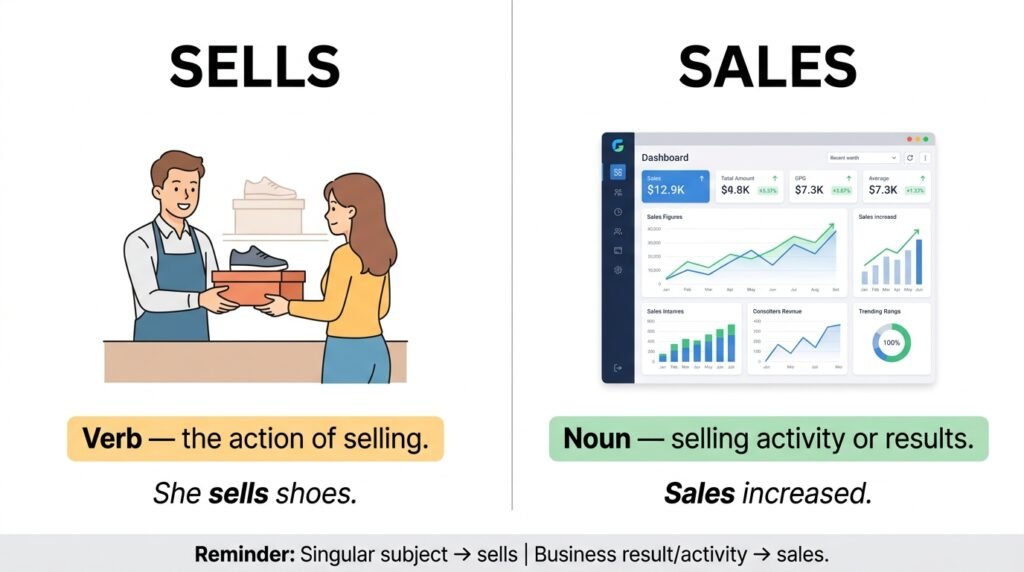

Sales and sells are both correct English words, but they have different grammatical jobs. Sales is mainly a noun referring to selling activity, a business department, or the number/value of products sold. Sells is normally the third-person singular present form of sell, as in “She sells clothes.” Choose sales when you are naming something; choose sells when a singular subject is performing the action of selling.
What Sells OR Sales Means
The words sales and sells come from the same basic word family, but they are not interchangeable.
Sales is used mainly as a noun. It can refer to the number or value of products sold, the activity of selling, or a company’s sales department. For example:
- Sales increased this year.
- She works in sales.
- The company reported strong sales.
Sells, on the other hand, is normally a verb. It is the third-person singular present form of “sell.” It is used with he, she, it, or another singular subject:
- He sells cars.
- She sells handmade bags.
- The store sells electronics.
There is also a less common noun use of sell, whose plural is sells, but that is not the normal meaning people have in mind when they confuse sales and sells. In everyday English, the useful distinction is simple: sales usually names the selling activity or its results, while sells describes someone or something performing the action.
The Main Difference
The biggest difference is grammar.
| Word | Main grammatical role | Basic idea |
|---|---|---|
| Sales | Noun | Selling activity, products sold, revenue/results, or sales department |
| Sells | Verb | The action of selling performed by he, she, it, or a singular noun |
Compare these sentences:
Our sales increased.
Here, sales names a business result.
Our company sells software.
Here, sells describes what the company does.
This is why you cannot normally replace one with the other:
- ❌ Our company sales software.
- ✅ Our company sells software.
And:
- ❌ Our company sells increased last year.
- ✅ Our company sales increased last year.
The two words may look similar, but the sentence structure tells you which one you need.
A useful way to think about it is:
Sales = the thing/result/activity being discussed.
Sells = the action performed by a singular subject.
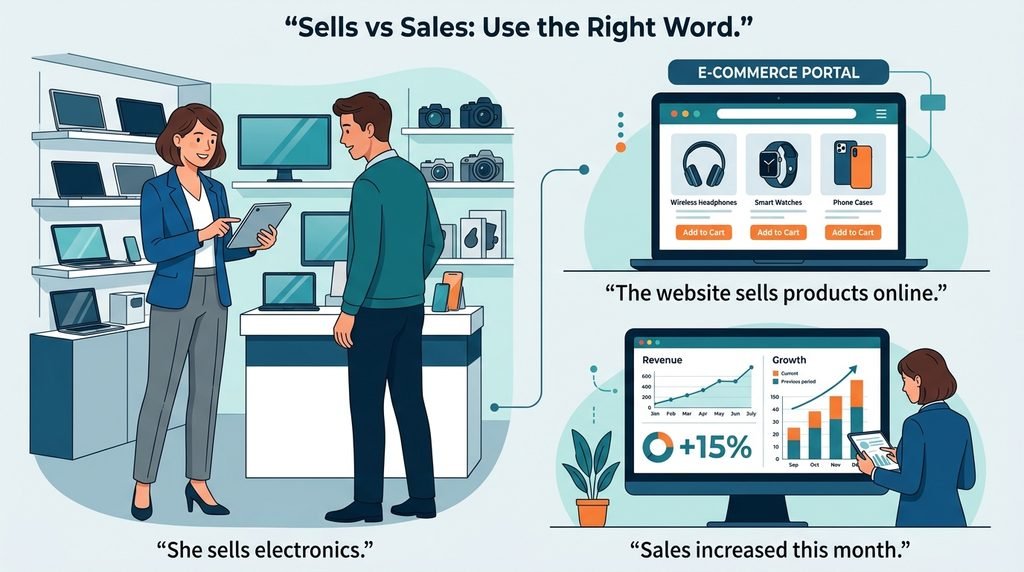
The Core Rule
The Rule in Simple English
Use sales when the word is functioning as a noun.
Use sells when you need the present-tense verb sell with a singular third-person subject.
Examples:
- The company’s sales are growing.
- The company sells computers.
- Her sales were excellent.
- She sells computers.
- I work in sales.
- He sells insurance.
A particularly useful grammar pattern is:
I/you/we/they → sell
he/she/it → sells
So:
- They sell shoes.
- We sell furniture.
- She sells shoes.
- He sells furniture.
- The store sells shoes.
Notice that sales is completely different from this subject-verb pattern. It is a noun, not the third-person form of sell.
Why the Rule Works
English often changes the form of a word depending on its grammatical function.
The base verb is:
sell
Its present-tense forms include:
- I sell
- you sell
- we sell
- they sell
- he sells
- she sells
- it sells
The noun sale has a different relationship to the verb. Its plural is sales.
So the spelling difference is meaningful:
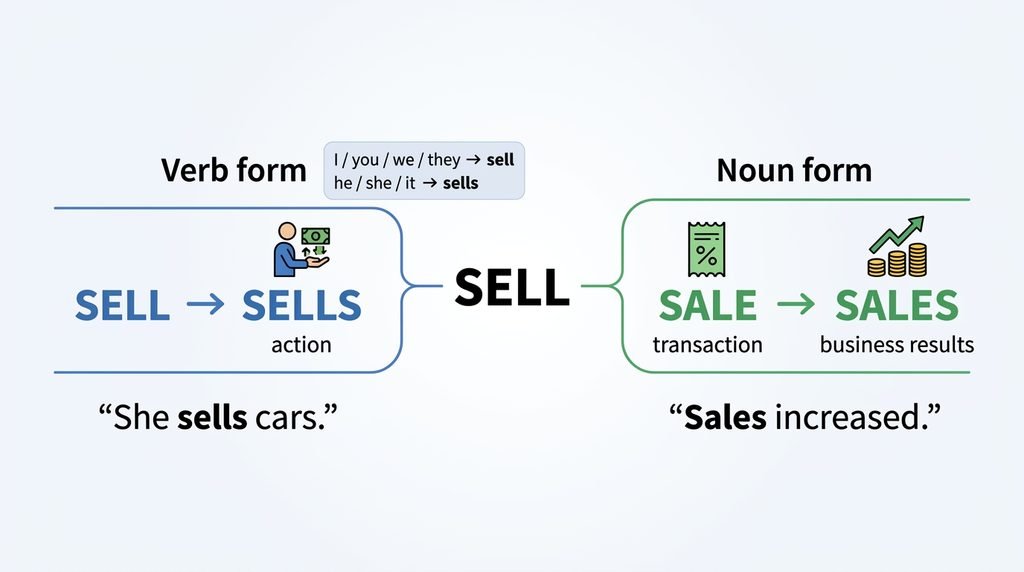
sell → sells = verb form
sale → sales = noun form
That explains why sales and sells look so similar while performing different jobs.
How to Use It
Common Usage
Sales commonly appears when discussing business results, products sold, selling activity, or a department within an organization.
Examples include:
- Sales increased by 15% this quarter.
- The sales department needs more staff.
- Online sales have grown rapidly.
- She has worked in sales for five years.
- The company published its annual sales figures.
Sells commonly appears when describing what a person, business, website, store, or product does.
Examples:
- She sells handmade jewelry.
- The website sells digital courses.
- That store sells fresh bread.
- The company sells software to small businesses.
- This model sells well in winter.
There is another useful pattern: something can sell well.
This book sells well.
Here, sells means that the book is successfully purchased by customers. The book is not necessarily the person performing the selling; English can use sell in this way to describe how well a product is bought.
Less Common or Special Usage
Sales can appear before another noun:
- sales manager
- sales team
- sales report
- sales strategy
- sales department
- sales target
- sales figures
In these combinations, sales functions as a noun used attributively to describe another noun. It is often informally described as an adjective, but grammatically it is more precise to call it a noun modifier or attributive noun.
There is also a less common noun sell, with plural sells, in expressions such as a tough sell. For example:
Convincing the committee will be a tough sell.
This is a specialized use and is not the normal reason learners search for sales vs. sells. For ordinary business and everyday writing, the main distinction remains sales = noun and sells = verb.
Correct Examples
Here are natural examples showing how the two forms work:
- The company’s sales increased significantly this year.
- She sells handmade candles online.
- Our sales team meets every Monday.
- That store sells imported coffee.
- Online sales are growing quickly.
- He sells insurance to small businesses.
- The company reported record sales.
- This website sells educational courses.
- Their international sales have doubled.
- My brother sells used computers.
- Sales were lower than expected in January.
- The supermarket sells fresh vegetables.
- She works in sales and marketing.
- The new product sells particularly well during the holidays.
- The business wants to increase sales this quarter.
These examples show that the choice depends on what the word is doing in the sentence, not simply on the subject matter.
Incorrect vs Correct
| ❌ Incorrect | ✅ Correct | Why |
|---|---|---|
| The store sales phones. | The store sells phones. | The store performs the action, so use the verb sells. |
| She sales clothes online. | She sells clothes online. | She needs the third-person singular verb sells. |
| He sales cars. | He sells cars. | Sells is the correct present-tense verb form. |
| The company sells increased last year. | The company’s sales increased last year. | The increase concerns the noun sales. |
| Our sells are growing. | Our sales are growing. | Business results are sales, not sells. |
| Their sells figures are impressive. | Their sales figures are impressive. | The established noun modifier is sales. |
| The website sales digital products. | The website sells digital products. | A website can perform the selling action. |
| Her sells were excellent this month. | Her sales were excellent this month. | The results are called sales. |
| The company sales products worldwide. | The company sells products worldwide. | Sells is the verb. |
| We need to improve our sells. | We need to improve our sales. | The business result is sales. |
A useful warning: not every sentence containing sales should be treated as a simple plural noun. In “She works in sales,” for example, sales refers to the activity or business function of selling and is commonly treated as an uncountable noun. In “Sales increased,” it refers to the number or value of products sold and is plural. Also you can read more here Words Gap.
Why People Make This Mistake
The confusion is understandable because sales and sells are visually very close.
There are several reasons.
1. They Come From the Same Word Family
Both words are connected to sell.
- sell → sells
- sale → sales
Because the words share related meanings, learners may remember the general idea of “selling” without remembering which grammatical form the sentence requires.
2. Both End in “-s”
The ending -s can be confusing.
In sells, the -s marks the third-person singular present form of a verb:
She sells books.
In sales, the -s is part of the plural noun sale → sales, although sales also has uncountable uses in business English.
So the same-looking ending does not mean the same grammatical thing.
3. They Sound Similar
In standard English, sales and sells are pronounced differently:
- sales /seɪlz/
- sells /selz/
The vowel in sales is the long /eɪ/ sound, while sells has the /e/ sound found in sell.
When people are typing quickly, however, they may rely on the sound or general meaning instead of checking the grammatical role.
4. Spellcheck May Not Help
Both sales and sells are correctly spelled English words.
Therefore, a spelling checker may not identify a grammatical substitution such as:
The company sales computers.
The problem is not that sales is misspelled. The problem is that the wrong correctly spelled word has been selected.
Common Mistakes
Mistake 1 — Using “Sales” as the Verb
A common error is:
❌ She sales clothes online.
The correct sentence is:
✅ She sells clothes online.
Ask yourself whether the word describes what she does. If yes, you need the verb sells.
Mistake 2 — Using “Sells” for Business Results
Another error is:
❌ The company’s sells increased.
Use:
✅ The company’s sales increased.
Here, you are talking about the amount or number of things sold, so sales is the appropriate noun.
Mistake 3 — Forgetting Subject-Verb Agreement
Even when you know that sells is the verb, you must use it with the right subject.
- She sells.
- He sells.
- It sells.
- The company sells.
But:
- They sell.
- We sell.
- I sell.
- You sell.
Therefore:
❌ They sells shoes.
✅ They sell shoes.
Mistake 4 — Confusing “Sale” and “Sales” Too
The related noun sale creates another common problem.
- We made a sale. = one transaction
- We made several sales. = more than one
- Our sales increased. = overall sales/results
So sale, sales, sell, and sells should not be treated as interchangeable forms.
Sells OR Sales in Real English
Real English makes the distinction clearer when you look at complete sentence patterns.
Consider these four sentences:
I sell shoes.
Sell is the base verb.
She sells shoes.
Sells is the third-person singular present form.
The sale was successful.
Sale is a noun referring to an individual transaction or selling event.
Our sales were strong.
Sales refers to sales results or the amount/number sold.
This gives you a useful word family:
sell → sells → sold → selling
and
sale → sales
The forms are related, but each has its own grammatical role.
There is also a difference between correctness and naturalness. For example, “The store sells shoes” is a natural everyday sentence. “The store makes sales of shoes” may be grammatically understandable, but native speakers would normally choose a simpler structure such as “The store sells shoes” or “The store’s shoe sales are strong.”
The goal is therefore not merely to construct a sentence that can be understood. Choose the form that naturally fits the meaning and grammatical structure.
American vs British English
There is no meaningful American-versus-British spelling difference between sales and sells.
Both major varieties use:
- sales for the relevant noun uses
- sells as the third-person singular present form of sell
For example:
American English:
The company sells software.
British English:
The company sells software.
Likewise:
American English:
Sales increased this year.
British English:
Sales increased this year.
The core distinction is grammatical rather than regional.
Comparison Table
| Feature | Sales | Sells |
|---|---|---|
| Main role | Noun | Verb |
| Related base | Sale | Sell |
| Basic meaning | Selling activity, amount/value sold, or sales function | Performs the action of selling |
| Typical subject | Not applicable in the same way | He, she, it, or singular noun |
| Example | Sales increased. | She sells cars. |
| Business use | Sales department, sales figures, sales growth | Company/store/person performs selling |
| Pronunciation | /seɪlz/ | /selz/ |
| Common error | Using it as a verb | Using it as a noun |
| Plural meaning | Often refers to multiple sales/results | Not normally a plural noun in ordinary learner usage |
Memory Trick
Use this simple question:
“Am I naming the selling result/activity, or am I describing the action?”
If you are naming the result, activity, or business function:
→ SALES
Sales increased.
If you are describing what a singular person, company, store, or thing does:
→ SELLS
The store sells shoes.
Another quick pattern is:
She sells.
They sell.
Sales grow.
Remember:
One person/company does it → sells.
The business result/activity → sales.
And do not confuse sells with sale. The latter is a noun for an individual transaction or selling event.
Real-Life Examples
At Work
Business communication frequently uses both words:
Our sales increased by 8% this quarter.
Here, sales refers to the business result.
The company sells software to hospitals.
Here, sells describes the company’s activity.
Please send the latest sales report.
Here, sales modifies report.
Our new representative sells directly to customers.
Here, sells is the verb.
In an Email
You might write:
Our sales team will contact you tomorrow.
Or:
Our company sells a range of business software.
But you would not write:
❌ Our company sales a range of business software.
The correct verb is sells.
In Conversation
Someone might ask:
What does your company sell?
You could answer:
We sell office furniture.
If you are talking about performance, you might say:
Our sales have been strong this month.
The same conversation can naturally contain both words because they perform different grammatical functions.
At School or University
A student writing about a business might say:
The company sells products through its website.
Later, the student might write:
Its online sales increased significantly.
Both sentences are correct because the first describes an action and the second describes a business result.
Expert Tips
- Find the verb first.
If the sentence needs a verb meaning “offer something for money,” use sell or sells, depending on the subject. - Check the subject.
He/she/it/company/store → sells.
I/you/we/they → sell. - Look for business-result language.
Words such as figures, growth, revenue, increase, decline, report, targets, and numbers often appear with sales. - Remember “sales team.”
A team that handles selling is a sales team, not a “sells team.” - Do not trust spelling alone.
Both forms are correctly spelled. Grammar determines the choice. - Remember the word family.
sell → sells → selling → sold
sale → sales - Use the sentence test.
If you can replace the word with an action such as offers or provides and the structure still works, you may need a verb such as sells. - Do not assume every “-s” means plural.
In sells, the ending marks third-person singular present tense. In sales, the form can represent the plural of sale or the established business noun sales.
Quick Summary
Sales and sells are both correct, but they cannot normally be substituted for each other. Sales is a noun used for the number or value of products sold, the activity or function of selling, and related business contexts such as sales team and sales report. Sells is normally the third-person singular present form of sell, used with he, she, it, or a singular noun: She sells clothes or The store sells computers. The fastest way to choose is to identify the grammatical job. If you are naming the selling activity or result, use sales. If a singular subject is performing the action, use sells.
Frequently Asked Questions
Is “sales” correct English?
Yes. Sales is a standard English word. It can refer to the number or value of products sold, the activity of selling, or a business sales department or function.
Is “sells” correct English?
Yes. Sells is the normal third-person singular present form of sell.
She sells books.
The company sells software.
Is “sales” a verb?
Normally, no. In standard everyday English, sales is used as a noun. If you need the verb meaning “to offer or exchange something for money,” use sell or sells according to the subject.
Is “sells” plural?
Usually, when learners encounter sells, it is the third-person singular verb form:
He sells cars.
There is also a less common noun sell, whose plural can be sells, but this is a specialized usage and is not the ordinary meaning in the sales vs. sells question.
Should I write “the company sells” or “the company sales”?
Write:
The company sells products.
Company is a singular subject, so the verb is sells.
Should I write “company sales” or “company sells”?
It depends on what follows and what you mean.
The company’s sales increased.
Here, sales is the noun describing business results.
The company sells furniture.
Here, sells is the verb describing the company’s action.
What is the difference between sale and sales?
Sale can refer to one transaction or one selling event.
We made a sale.
Sales can refer to multiple sales, the number/value of products sold, or the business activity/function of selling.
Our sales increased.
What is the difference between sell and sells?
Sell is the base form used with I, you, we, they and after modal verbs such as can.
They sell shoes.
We can sell the product.
Sells is used with a third-person singular subject in the simple present.
She sells shoes.
The store sells shoes.
Which is correct: “sales are” or “sales is”?
When sales refers to the number or value of products sold, it is normally treated as plural:
Sales are increasing.
When sales refers to the business activity or department, it can behave as an uncountable noun:
Sales is a competitive field.
She works in sales.
The exact construction therefore depends on the meaning of sales.
Is “sales team” correct?
Yes. Sales team is a standard expression for a team responsible for selling products or services. Here sales functions as a noun modifier before team.
What is an easy way to remember sales vs. sells?
Think:
She SELLS. → action
Sales GROW. → business result
If a person or company is doing the selling, you will often need sells with a singular subject. If you are discussing the results or activity of selling, sales is usually the right choice.
Mini Quiz
| # | Question | Answer | Explanation |
|---|---|---|---|
| 1 | The store ___ computers. (sales / sells) | sells | “The store” is a singular subject performing the action. |
| 2 | Our ___ increased last quarter. (sales / sells) | sales | The sentence refers to business results. |
| 3 | She ___ handmade bags online. (sales / sells) | sells | “She” takes the third-person singular verb sells. |
| 4 | The company reported strong ___. (sales / sells) | sales | Strong business results are described as sales. |
| 5 | Which is correct? (They sell cars / They sells cars) | They sell cars. | They takes the base verb sell, not sells. |
| 6 | Complete: “He ___ insurance.” | sells | “He” requires the third-person singular present form. |
| 7 | Complete: “Online ___ are growing.” | sales | The sentence refers to the amount/activity of products sold. |
| 8 | Identify the error: “The website sales shoes.” | sales → sells | The website is performing the selling action, so sells is needed. |
| 9 | Which phrase is correct? (sales report / sells report) | sales report | Sales is used as a noun modifier before report. |
| 10 | Which sentence is correct? (The company’s sales increased / The company’s sells increased) | The company’s sales increased. | Sales is the noun referring to the company’s selling results. |


Pingback: Esthetically or Aesthetically: Which Spelling Is Correct?