


Emigrate means to leave one country to live in another, while immigrate means to come into another country to live there. The difference is mainly about point of view: you emigrate from the country you leave and immigrate to the country you enter. For example, someone can emigrate from Pakistan and immigrate to Canada. The two words can describe the same international move from opposite perspectives.
What Emigrate or Immigrate Means
Emigrate and immigrate are verbs used when talking about moving from one country to another, usually to live there for the long term or permanently.
The simplest distinction is:
- Emigrate = leave a country to live somewhere else.
- Immigrate = enter another country to live there.
Consider a person moving from Country A to Country B.
From the perspective of Country A:
She emigrated from Country A.
From the perspective of Country B:
She immigrated to Country B.
It is the same person and the same move. The verb changes because the sentence focuses on a different side of the journey.
The related nouns follow the same distinction:
- emigration = the act or process of leaving a country
- emigrant = a person who leaves a country to live elsewhere
- immigration = the act or process of entering another country to live there
- immigrant = a person who comes to another country to live there
So, a person can be both an emigrant and an immigrant at the same time, depending on which country is being discussed.
ALSO READ: Presenter or Presentor: Which Spelling Is Correct?
The Main Difference
The main difference is direction and viewpoint.
| Word | Main idea | Focus |
|---|---|---|
| Emigrate | Leave a country | Where the person leaves |
| Immigrate | Enter another country to live | Where the person arrives |
For example:
Omar emigrated from Pakistan.
This focuses on Pakistan as the country he left.
Omar immigrated to Canada.
This focuses on Canada as the country where he arrived to live.
Both statements can describe Omar’s same move.
You can even combine both:
Omar emigrated from Pakistan and immigrated to Canada.
There is no contradiction. The first verb describes the departure, and the second describes the arrival.
A Simple Direction Test
Ask yourself:
Am I focusing on leaving?
Use emigrate.
Am I focusing on entering a new country?
Use immigrate.
This is much more reliable than trying to remember the two words as alternative spellings.
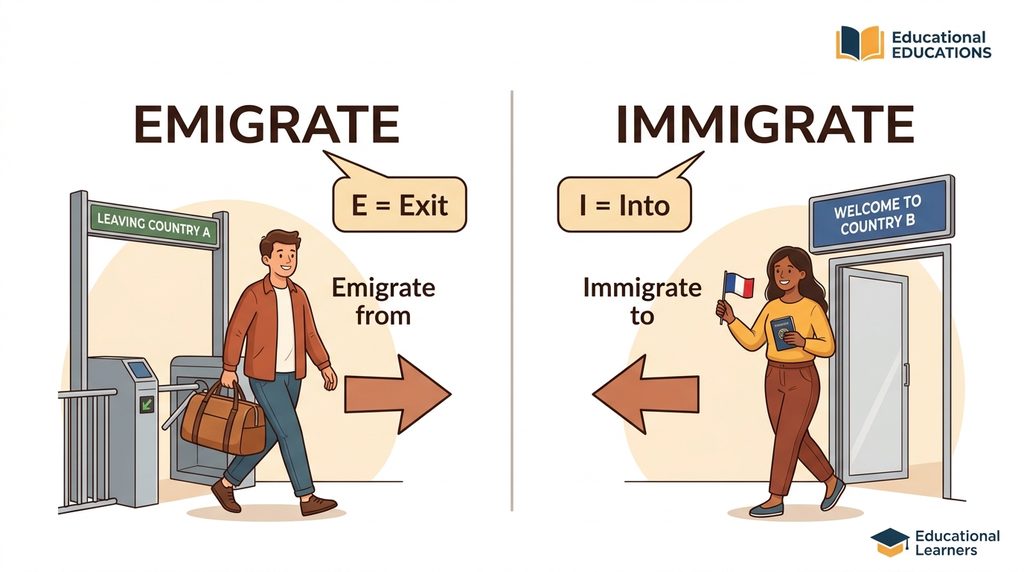
The Core Rule
The Rule in Simple English
Think:
Emigrate = exit
Immigrate = into
So:
emigrate from a country
and:
immigrate to a country
For example:
They emigrated from Brazil.
They immigrated to Australia.
The same people can be described in one sentence:
They emigrated from Brazil and immigrated to Australia.
The important point is that emigrate and immigrate are not interchangeable spellings. They are two different verbs with related but opposite perspectives.
Why the Rule Works
The prefixes help explain the distinction.
The e- in emigrate is historically related to a form meaning out, while im- in immigrate comes from in/into. The shared part, -migrate, relates to movement.
That gives you a useful conceptual contrast:
E → Exit → Emigrate
I → In → Immigrate
This is a memory aid rather than a reason to assume every sentence must contain from or to.
For example:
Thousands emigrated during the economic crisis.
The destination does not need to be mentioned.
Likewise:
Her parents immigrated when she was young.
The destination can be understood from context.
The central meaning still depends on whether the sentence views the movement as leaving or entering.
ALSO READ: Driers or Dryers: Meaning, Spelling, and Usage Differences.
How to Use It
Common Usage
Emigrate is commonly used when the sentence emphasizes the country or place someone leaves.
Typical patterns include:
- emigrate from a country
- emigrate to another country
- emigrate from one country to another
- decide to emigrate
- plan to emigrate
- choose to emigrate
Examples:
His grandparents emigrated from Italy after the war.
Many families decided to emigrate in search of better opportunities.
She emigrated from India to the United Kingdom in her twenties.
Immigrate is used when the sentence emphasizes the country someone enters and begins living in.
Typical patterns include:
- immigrate to a country
- immigrate into a country
- immigrate from another country
- decide to immigrate
- plan to immigrate
- immigrate as a family
Examples:
Her family immigrated to Canada in 2005.
They decided to immigrate to Australia.
He immigrated from Kenya as a child.
The last example is possible because the sentence can identify the origin while still using immigrate. The word’s core meaning remains centered on coming into a new country.
Less Common or Special Usage
The distinction becomes especially important in writing about population movement.
If a report discusses people leaving a country, it may talk about emigration.
If it discusses people entering a country, it may talk about immigration.
For example:
The country experienced a rise in emigration.
This means more people were leaving.
The country experienced a rise in immigration.
This means more people were coming in from other countries.
The two processes can happen simultaneously.
A country may have people emigrating while other people are immigrating.
Correct Examples
- My grandparents emigrated from Poland many years ago.
- Her parents immigrated to Canada before she was born.
- Thousands of families emigrated from the region during the conflict.
- He plans to immigrate to Australia after completing his studies.
- Sara emigrated from Pakistan and immigrated to the United Kingdom.
- Their family emigrated from Ireland to the United States.
- Many people chose to emigrate when economic conditions became difficult.
- His parents immigrated when he was only six years old.
- The article discusses the country’s increasing emigration rate.
- The new policy affected people hoping to immigrate to the country.
- Her grandparents emigrated from Greece in the 1960s.
- Daniel was born abroad after his parents immigrated.
- The family eventually emigrated to New Zealand.
- She had relatives who had immigrated from several different countries.
- One person can emigrate from one country and immigrate to another during the same move.
Incorrect vs Correct
| ❌ Incorrect or Misleading | ✅ Correct | Why |
|---|---|---|
| He immigrated from his country to another one, so he emigrated to it. | He emigrated from his country and immigrated to another one. | The two verbs describe opposite perspectives. |
| She emigrated to Canada, so Canada is the country she left. | She immigrated to Canada if Canada is the destination. | Immigrate to normally focuses on entering the destination country. |
| My parents immigrated from Pakistan to Canada. | My parents emigrated from Pakistan to Canada. | If the sentence focuses on leaving Pakistan, emigrated is the clearer choice. |
| My parents emigrated from Canada after moving there to live. | My parents immigrated to Canada after leaving their home country. | Canada is the destination, so immigrated expresses arrival. |
| He immigrated to France because he left France. | He emigrated from France because he left France. | The focus is departure. |
| She emigrated from Germany because she entered Germany to live. | She immigrated to Germany because she entered Germany to live. | The focus is arrival. |
| They immigrated to Brazil when they left Brazil. | They emigrated from Brazil when they left Brazil. | From identifies the departure point. |
| We emigrated to the United States, meaning we became immigrants from the United States. | We immigrated to the United States and became immigrants there. | An immigrant is associated with the country entered. |
| He is an emigrant to the country he entered. | He is an immigrant to the country he entered. | Emigrant emphasizes the country left. |
| The country received thousands of emigrants from abroad. | The country received thousands of immigrants from abroad. | People arriving are immigrants from the destination country’s perspective. |

A useful caution: some of the “incorrect” examples above are misleading because they reverse the normal perspective. They are not necessarily examples of impossible English in every imaginable context. The key issue is whether the chosen verb matches the intended viewpoint.
For example, “They emigrated to Canada” can occur in real English because emigrate focuses on leaving even though the destination is also mentioned. The clearest learner pattern is still emigrate from and immigrate to.
Why People Make This Mistake
There are several reasons emigrate and immigrate are easy to confuse.
They Look Almost Identical
Both words contain -migrate:
- emigrate
- immigrate
Only the beginning changes.
That makes it easy to remember the spelling but forget the meaning.
They Describe the Same Journey
This is the biggest reason for confusion.
Imagine someone traveling from Pakistan to Canada.
It is one physical journey, but English can describe it in two ways:
He emigrated from Pakistan.
and:
He immigrated to Canada.
Because both statements describe the same person and event, learners may assume the words are interchangeable.
They are not. The viewpoint changes.
The Prefixes Are Easy to Overlook
The first letters carry useful meaning:
E = Exit
I = Into
The rest of the words are almost identical, so the small difference at the beginning can be overlooked while speaking or writing.
Prepositions Can Add Confusion
Learners often memorize:
emigrate + from
and:
immigrate + to
These are excellent patterns to learn, but they should not become rigid rules.
English can use these verbs with additional information about origin or destination depending on context.
The real rule is departure versus arrival, not simply from versus to.
Common Mistakes
Mistake 1 — Treating Them as Alternative Spellings
A common mistake is thinking that one spelling is correct and the other is a variation.
They are both correct words.
The choice depends on meaning.
She emigrated from Pakistan.
She immigrated to Canada.
Neither word is the “correct spelling” of the other.
Mistake 2 — Using Immigrate for Leaving
If you want to emphasize that someone left a country, emigrate is normally the appropriate verb.
He emigrated from Spain.
Not:
He immigrated from Spain.
The second sentence can occur when the origin is supplied as additional information, but if the intended meaning is specifically “he left Spain,” emigrated is the clearer choice.
Mistake 3 — Using Emigrate for Entering
If the destination country is the focus, immigrate is normally the better choice.
She immigrated to Canada.
The sentence emphasizes her arrival and settlement in Canada.
Mistake 4 — Thinking One Person Cannot Be Both
A person can be both an emigrant and an immigrant.
For example:
Ahmed emigrated from Pakistan and immigrated to Germany.
From Pakistan’s perspective, Ahmed is an emigrant.
From Germany’s perspective, Ahmed is an immigrant.
There is no contradiction.
Mistake 5 — Confusing Both Words with Migrate
Migrate is broader.
It can describe movement from one place to another and does not carry the same specific departure/arrival viewpoint.
For example:
Many birds migrate south in winter.
You would not normally replace migrate with immigrate or emigrate in that sentence.
Emigrate or Immigrate in Real English
In real English, the most useful distinction is not simply “which word is correct?” but which viewpoint does the sentence need?
Correct and Natural
These are straightforward:
She emigrated from Mexico.
She immigrated to Canada.
They clearly identify departure and arrival.
Correct but Less Direct for Learners
You may encounter:
She emigrated to Canada.
This is possible because emigrate can describe leaving one’s country while also naming the destination.
Likewise, you may encounter:
She immigrated from Mexico.
This can be grammatically possible when from Mexico supplies information about the origin.
For learners, however, the clearest basic patterns remain:
emigrate from the country you leave
immigrate to the country you enter
When the Destination or Origin Is Not Mentioned
Neither word requires the other country to be explicitly named.
For example:
His family emigrated in the 1980s.
This emphasizes leaving without identifying the destination.
Similarly:
Her parents immigrated when she was a child.
The destination may already be clear from the surrounding conversation.
ALSO READ: Breach or Breech: Meaning, Difference & Correct Usage
When “Migrate” Is Better
Use migrate when you are talking about movement generally rather than specifically describing immigration or emigration.
For example:
Thousands of workers migrated to the city for seasonal employment.
The word migrate can be useful when the movement is temporary, internal, seasonal, or otherwise not being described specifically as immigration into another country.
Formal vs Informal Usage
Formal Usage
Both emigrate and immigrate are standard words and are appropriate in formal writing.
They are common in contexts such as:
- academic writing
- history
- demographic reports
- government writing
- journalism
- professional communication
- discussions of international migration
Examples:
The study examines patterns of emigration among young professionals.
The policy affects people seeking to immigrate to the country.
Everyday Usage
In casual conversation, people often simply say move, especially when the exact immigration/emigration viewpoint is not important.
For example:
My family moved to Canada when I was young.
This is often more natural in everyday conversation than choosing between emigrated and immigrated.
However, when the direction of migration matters, the specific verbs are useful:
My grandparents emigrated from Italy.
They later immigrated to Argentina.
Comparison Table
| Feature | Emigrate | Immigrate |
|---|---|---|
| Basic meaning | Leave a country to live elsewhere | Come into another country to live |
| Main focus | Departure | Arrival |
| Typical viewpoint | Country being left | Country being entered |
| Common learner pattern | emigrate from | immigrate to |
| Can destination be mentioned? | Yes | Yes |
| Can origin be mentioned? | Yes | Yes |
| Related noun | emigration | immigration |
| Related person | emigrant | immigrant |
| Same person can be both? | Yes | Yes |
| Example | She emigrated from India. | She immigrated to Canada. |
Memory Trick
Use the first letter:
E = Exit
Emigrate = Exit a country
I = Into
Immigrate = Into a country
Picture a person standing at a border.
When the person is going out, think:
E → Exit → Emigrate
When the person is going in, think:
I → Into → Immigrate
Then add the usual preposition pattern:
Emigrate from
Immigrate to
A complete memory sentence is:
I emigrated from my old country and immigrated to my new country.
That sentence captures both sides of the same journey.
Real-Life Examples
At Work
Our manager immigrated to the country with her family as a teenager.
Several employees emigrated from their home countries to pursue international careers.
His grandparents emigrated from Ireland and later established a business abroad.
In an Email
My parents emigrated from India in the early 1990s.
I am planning to immigrate to Australia next year.
My family emigrated from our home country and immigrated to the United States several years ago.
In Conversation
“Where did your grandparents come from?”
“They emigrated from Greece.”
Or:
“When did your family move here?”
“They immigrated to Canada when I was five.”
At School or University
The history course examines why people emigrated from Europe during different periods.
The paper discusses how immigrants adapted after they immigrated to the United States.
Students should distinguish emigration from immigration when discussing population movement.
Expert Tips
- Look at the country being discussed.
If it is the country someone left, think emigrate. If it is the country someone entered, think immigrate. - Do not memorize them as spelling variants.
They are different verbs with different viewpoints. - Use the preposition as a clue, not as the entire rule.
“From” strongly suggests emigrate, while “to” strongly suggests immigrate, but context ultimately determines the meaning. - Remember that one person can do both.
Someone can emigrate from Country A and immigrate to Country B. - Use “migrate” when you mean movement more generally.
This avoids forcing an immigration/emigration distinction when it is not needed. - Use “move” in ordinary conversation when precision is unnecessary.
“We moved to Canada” is simple and natural. - Check the viewpoint before correcting someone.
A sentence such as “They emigrated to Canada” is not automatically meaningless. The verb may be emphasizing the act of leaving rather than the arrival.
Quick Summary
Emigrate and immigrate are both correct English verbs, but they describe international movement from different viewpoints. Emigrate focuses on leaving a country, while immigrate focuses on entering another country to live there. The most useful patterns are emigrate from and immigrate to. For example, a person can emigrate from Pakistan and immigrate to Canada. The two verbs therefore can describe the same physical move without being interchangeable. Remember E = Exit for emigrate and I = Into for immigrate. Also remember that these are not rigid “from versus to” spelling rules: context and viewpoint determine the appropriate verb.
Frequently Asked Questions
Is “emigrate” correct?
Yes. Emigrate is a standard English verb meaning to leave one country to live in another.
Example:
Her family emigrated from Italy.
Is “immigrate” correct?
Yes. Immigrate is a standard English verb meaning to come to another country to live there.
Example:
Her family immigrated to Canada.
What is the easiest difference between emigrate and immigrate?
Think:
Emigrate = leave
Immigrate = enter
Or use:
E = Exit
I = Into
Can the same person emigrate and immigrate?
Yes. In fact, this is one of the most important points.
Someone can:
emigrate from Pakistan
and:
immigrate to Canada
The person leaves one country and enters another.
Is “emigrate from” correct?
Yes. Emigrate from is one of the clearest and most common patterns.
They emigrated from Germany.
It identifies the country the person left.
Is “immigrate to” correct?
Yes. Immigrate to is a standard pattern.
She immigrated to Australia.
It identifies the country she entered and moved to live in.
Can you say “emigrate to”?
Yes. The phrase can be used when emigrate is emphasizing the act of leaving, while the destination is also supplied.
Her family emigrated to Canada in 1998.
For learners, however, emigrate from is the easiest pattern for remembering the departure perspective.
Can you say “immigrate from”?
Yes. Immigrate from can appear when the origin is given as additional information.
He immigrated from India when he was a child.
The destination may already be known from context.
For the basic learner rule, however, remember that immigrate primarily focuses on the country entered.
Is “migrate” the same as “immigrate”?
No. Migrate is broader. It means to move from one place to another and can describe people, animals, populations, or seasonal movement.
Immigrate specifically concerns entering another country to live there.
Which is correct: “I emigrated to Canada” or “I immigrated to Canada”?
Both can be grammatically possible, but they emphasize different viewpoints. I immigrated to Canada directly emphasizes entering Canada to live there. I emigrated to Canada can emphasize leaving the previous country while also naming Canada as the destination.
If you simply want to say that Canada became your new country of residence, immigrated to Canada is the clearer choice.
Which is correct: “I emigrated from Pakistan” or “I immigrated from Pakistan”?
Both forms can occur depending on context, but they do not emphasize exactly the same thing. I emigrated from Pakistan clearly presents Pakistan as the country I left. I immigrated from Pakistan can identify Pakistan as my country of origin while the main focus is my arrival in another country.
For a simple departure statement, use emigrated from Pakistan.
Is an emigrant the same as an immigrant?
They can refer to the same person, but from different perspectives.
A person leaving Pakistan is an emigrant from Pakistan.
The same person arriving in Canada is an immigrant to Canada.
What is the difference between emigration and immigration?
Emigration refers to leaving a country.
Immigration refers to entering another country to live there.
The difference between the nouns follows the same departure-versus-arrival distinction as the verbs.
Mini Quiz
| # | Question | Answer | Explanation |
|---|---|---|---|
| 1 | She ___ from Spain and moved to France. | emigrated | The sentence focuses on leaving Spain. |
| 2 | They ___ to Canada in 2010. | immigrated | Canada is the destination they entered to live. |
| 3 | Which word means “leave a country to live elsewhere”? | emigrate | Emigrate focuses on departure. |
| 4 | Which word focuses on entering a new country? | immigrate | Immigrate focuses on arrival in another country. |
| 5 | Complete: “He ___ from Brazil and ___ to Portugal.” | emigrated; immigrated | He left Brazil and entered Portugal. |
| 6 | Which is the clearest basic pattern: “emigrate ___ a country”? | from | The country named after from is the departure point. |
| 7 | Which is the clearest basic pattern: “immigrate ___ a country”? | to | The country named after to is the destination. |
| 8 | True or false: A person can be both an emigrant and an immigrant. | True | The same person can leave one country and enter another. |
| 9 | Choose the better word: “My parents ___ to Australia when I was five.” | immigrated | The sentence focuses on Australia as the destination. |
| 10 | Choose the better word: “My grandparents ___ from Italy in the 1960s.” | emigrated | The sentence focuses on Italy as the country they left |


Pingback: Cheat or Repeat: Meaning, Difference and Correct Usage
Pingback: Petit or Petite: What’s the Difference and Which One Is Correct?