


If you mean a person, thing, or situation that does not follow a general rule, the correct modern English word is exception. Acception is not simply an alternative spelling of exception. It is a rare, chiefly historical English word that has been used for meanings connected with acceptance or the received sense of a word. In ordinary modern writing, use exception, acceptance, or meaning/sense, depending on what you mean.
What “Exception” and “Acception” Mean
What does “exception” mean?
Exception is a noun meaning something or someone that does not follow a general rule, pattern, condition, or expectation.
For example:
- There is one exception to the rule.
- The discount applies to every item, with one exception.
- She is usually early, but today was an exception.
- The policy allows no exceptions.
Exception is a normal, widely used word in modern English. It appears in everyday conversation as well as academic, business, legal, technical, and professional writing.
What does “acception” mean?
Acception is a real English word, but it is extremely uncommon in contemporary English. Historically, it could refer to acceptance or reception, and it was also used for the received or particular sense of a word.
For example, an older text might refer to a word’s particular “acception” when discussing the sense in which that word is being used.
Today, however, sense, meaning, interpretation, or acceptance will usually be clearer and more natural, depending on the intended meaning.
That distinction is important: seeing acception in an old dictionary or historical text does not mean it is a modern spelling variant of exception.
The Main Difference
The simplest distinction is:
| Word | Main idea | Modern status |
|---|---|---|
| exception | Something outside a general rule or pattern | Common and standard |
| acception | Historically, acceptance/reception or a particular sense of a word | Rare, historical, or obsolete in ordinary English |
| acceptance | The act or state of accepting something | Common and standard |
Consider these three sentences:
- There is an exception to the rule.
One case does not follow the rule. - The university sent her an acceptance letter.
She was accepted. - The word had a different acception in an older text.
The word was being used in a particular historical sense.
The spelling is similar, but the meanings are not interchangeable.
Also Read: Hustle or Hussle: Which Spelling Is Correct?
The most useful rule
If you mean “a special case outside the rule,” use exception.
If you mean “the act or state of accepting,” use acceptance.
If you are discussing an older or historical sense of a word, you may encounter acception, but modern readers will often find sense or meaning clearer.
The Core Rule
The Rule in Simple English
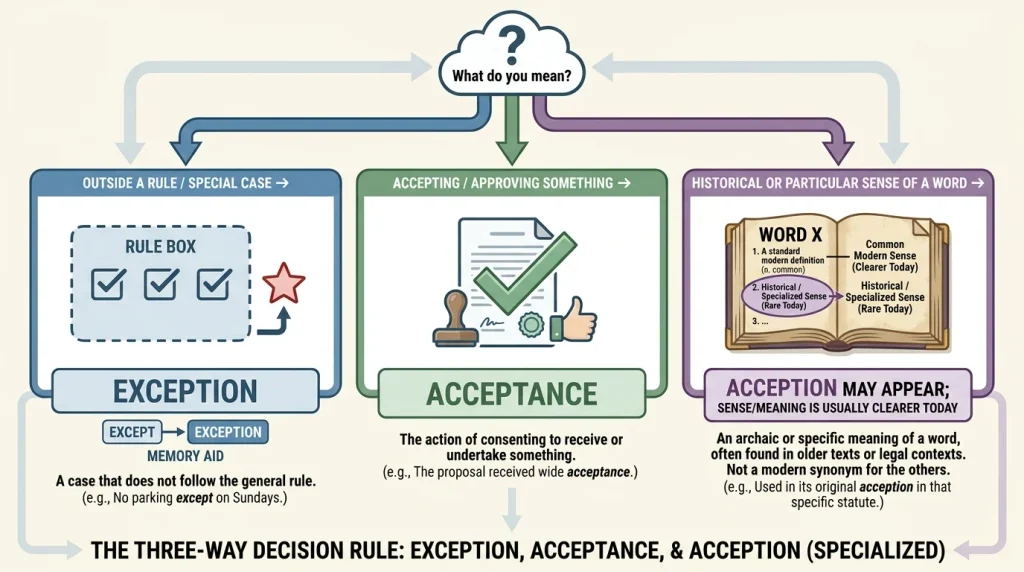
Ask yourself what your sentence is talking about:
Outside a rule or general pattern? → exception
Accepting, approving, or receiving something? → acceptance
A historical or particular sense of a word? → acception may appear
For most modern writing, this makes the decision straightforward.
Why the Rule Works
The confusion comes partly from the visual similarity between accept, acception, except, and exception.
But the modern words have different functions:
- accept = receive, agree to, or approve
- acceptance = the act or state of accepting
- except = exclude
- exception = something excluded from a general rule
- exceptional = unusual or unusually good
- acception = a rare/historical noun with older meanings connected with acceptance or a particular sense
The important connection for everyday writing is between except and exception.
Everyone came except Daniel.
can be expressed as:
Everyone came, with Daniel as the only exception.
That connection makes exception easier to remember.
How to Use It
Common Usage
Exception is used whenever a general rule, expectation, category, or pattern has a special case.
Common constructions include:
exception to a rule
There is an exception to this rule.
with the exception of
Everyone attended with the exception of Maya.
make an exception
The manager made an exception and approved the request.
without exception
Every applicant must complete the form without exception.
take exception to
He took exception to the accusation.
The last expression has a different meaning: take exception to something means to object to it or feel offended by it.
Less Common or Special Usage
You may encounter acception in older English, historical dictionaries, or specialized discussions of historical terminology.
For example:
The historian examined the word in its older acception.
In modern general-purpose writing, however, this would usually be clearer as:
The historian examined the word in its older sense.
If you are writing for a general audience, choosing the familiar modern word is normally better.
Do not use acception simply because you want a noun related to accept. The normal modern noun is acceptance.
Correct Examples
- There is one exception to the attendance policy.
- Everyone received a certificate, with one exception.
- The restaurant is open every day, with the exception of Monday.
- The teacher made an exception for students who were traveling.
- We normally require payment in advance, but we made an exception this time.
- No exceptions will be made after the deadline.
- She is usually very patient, so her reaction was an exception.
- The new policy applies to all employees without exception.
- The company approved his request as an exception to the normal procedure.
- The university sent her an acceptance letter.
- His acceptance of the offer arrived by email.
- The historian discussed an older acception of the term in the manuscript.
The first ten examples show ordinary modern uses of exception or the closely related acceptance. The final example illustrates the historical/specialized use in which acception may still be encountered.
Incorrect vs Correct
The “incorrect” examples below mean incorrect for the intended modern meaning. They do not mean that the word acception has never existed in English.
| ❌ Incorrect | ✅ Correct | Why |
|---|---|---|
| There is one acception to the rule. | There is one exception to the rule. | The sentence refers to a case outside a rule. |
| We made an acception for the customer. | We made an exception for the customer. | A special allowance is an exception. |
| No acceptions will be permitted. | No exceptions will be permitted. | The policy excludes special cases. |
| Friday is an acception to the normal schedule. | Friday is an exception to the normal schedule. | Friday differs from the general schedule. |
| The law contains several acceptions. | The law contains several exceptions. | The sentence concerns provisions outside the general rule. |
| She received acception into the program. | She received acceptance into the program. | Acceptance means being accepted. |
| His acception of the offer was immediate. | His acceptance of the offer was immediate. | The intended meaning is agreement to an offer. |
| The company announced its acception of the proposal. | The company announced its acceptance of the proposal. | Acceptance is the standard modern noun. |
| What is the first acception of this word? | What is the first meaning or sense of this word? | Modern English normally uses meaning or sense here. |
| The rule applies to everyone with no acception. | The rule applies to everyone with no exception. | The intended meaning is “with no special cases.” |
Notice that the correction is not always exception. In several sentences, the real problem is that the writer means acceptance. In another type of sentence, meaning or sense is the natural modern choice.
That is why simply memorizing “exception is correct” is not enough.
Why People Make This Mistake
The confusion has several understandable causes.
Similar spelling
Acception and exception differ by only one letter:
- acception
- exception
Both also contain -ception, making them look as though they might be alternative spellings of the same word.
Similar sound
In English, acception and exception can be pronounced alike or very similarly, depending on the speaker and historical context. When two forms sound alike, spelling becomes especially easy to confuse.
The accept/except confusion
English already contains a well-known pair:
- accept = agree to or receive
- except = exclude
Adding nouns such as acceptance, acception, and exception makes the visual pattern more complicated.
Compare:
I accept the offer.
Everyone except Leo attended.
We received her acceptance.
Leo was the only exception.
The meanings become much clearer when you connect each noun to the verb or idea it actually represents.
The existence of historical “acception”
This is an especially important reason for the confusion.
If someone searches for acception, they may discover that it is not entirely invented. Historical English really did use the word. Older dictionaries recorded meanings associated with acceptance, reception, and the sense of a word.
So a spellchecker or dictionary entry does not necessarily mean that acception is a suitable modern replacement for exception.
A word can be historically legitimate without being a natural choice in contemporary everyday English.
Common Mistakes
Mistake 1: Writing “acception to the rule”
This is the most direct confusion.
❌ There is an acception to the rule.
✅ There is an exception to the rule.
A rule has exceptions—special cases that are outside its normal application.
Mistake 2: Using “acception” for “acceptance”
This is a different error.
❌ We are waiting for their acception of the proposal.
✅ We are waiting for their acceptance of the proposal.
If someone approves, agrees to, or receives something, acceptance is normally the word you need.
Mistake 3: Assuming “acception” is the British spelling
It is not.
Exception is used in both American and British English for the normal modern meaning. Acception is not a British spelling of exception.
Mistake 4: Assuming a dictionary entry means a word is common
Dictionaries preserve historical vocabulary as well as current vocabulary.
Finding acception in a historical dictionary does not make it interchangeable with exception in a modern email, essay, report, or conversation.
Mistake 5: Using a rare word when a clear word is available
Even in a specialist discussion, sense, meaning, or interpretation may be easier for readers to understand than acception.
Good writing is not only about whether a word can be defended historically. It is also about whether the word communicates the intended idea clearly to the intended reader.
exception or acception in Real English
The most important real-English distinction is between correctness and naturalness.
Exception: correct and natural
These are ordinary modern constructions:
There is an exception to the rule.
We made an exception for her.
This case is an exception.
The policy has several exceptions.
No special explanation is needed.
Acception: historically legitimate but not normally natural today
A sentence such as:
The word has a particular acception in this text.
may be understandable and can reflect historical terminology, but it is not the normal choice for general modern English.
For most readers, this is clearer:
The word has a particular sense in this text.
Or:
The word has a particular meaning in this text.
This is a useful lesson in vocabulary: a word can exist without being the word you should normally use.
Exception can also have specialized modern meanings
Exception is not limited to rules in ordinary life.
In computing, an exception is an event or condition that interrupts the normal flow of a program and may need to be handled by the software.
For example:
The application raised an exception when it tried to open the missing file.
That is a modern technical use, not a spelling variation of acception.
Comparison Table
| Feature | Exception | Acception |
|---|---|---|
| Part of speech | Noun | Noun |
| Main modern idea | A special case outside a rule or pattern | Rare/historical meanings involving acceptance or a particular sense |
| Everyday use | Common | Extremely uncommon |
| Professional writing | Common | Generally avoided unless historical terminology is intended |
| Academic use | Common | May occur in historical or specialized discussion |
| Meaning related to rules | Yes | No |
| Meaning related to accepting | No | Historical usage |
| Meaning related to a word’s sense | No | Historical/specialized usage |
| Better modern alternative for acceptance | — | acceptance |
| Better modern alternative for a word’s sense | — | sense or meaning |
| American/British spelling difference | None | Not an alternative spelling |
| Typical example | “There is one exception to the rule.” | “The term has an older acception.” |
The practical winner for ordinary modern English is clear: exception is the normal word when you mean a special case outside a rule.
Memory Trick

Use this simple contrast:
EXCEPT → EXCEPTION
If something is excepted—left out of a general rule—it is an exception.
Think:
EX = outside
So:
exception → outside the rule
For the other two ideas:
ACCEPT → ACCEPTANCE
If someone accepts an offer, proposal, invitation, or decision, the noun is normally acceptance.
And if you are talking about what a word means:
MEANING → SENSE
You usually do not need the rare word acception.
A three-question check makes the choice easy:
- Is something outside a rule? → exception
- Is someone accepting something? → acceptance
- Am I discussing an old or specialized sense of a word? → acception may appear; sense is usually clearer.
Real-Life Examples
At Work
The company normally requires manager approval, but the director made an exception.
The new policy applies to all departments without exception.
Her acceptance of the revised contract arrived this morning.
Do not write acception when you mean either the special case or the act of accepting.
In an Email
Please note that Friday is an exception to our normal delivery schedule.
We cannot make an exception to the deadline without prior approval.
Thank you for your acceptance of the revised terms.
These are the forms a reader would normally expect in professional communication.
In Conversation
I don’t usually drink coffee, but I’ll make an exception today.
Everyone was invited except Sam, so Sam was the only exception.
She accepted the invitation, and we received her acceptance later.
In everyday speech, exception and acceptance are natural; acception would sound highly unusual.
At School or University
There are several exceptions to this grammatical pattern.
All students must submit the assignment on time, with an exception for documented emergencies.
In historical linguistics or textual analysis, you may encounter:
The researcher examines the older acception of the term.
But in general student writing, sense, meaning, or interpretation will usually be clearer.
Also Read: Shavasana or Savasana: Meaning, Spelling & Difference.
Expert Tips
Tip 1: Check the meaning before checking the spelling
Do not ask only:
“Which spelling looks right?”
Ask:
“What am I trying to say?”
If you mean a special case, choose exception.
If you mean approval or agreement, choose acceptance.
Tip 2: Remember “except → exception”
This is the most useful connection for the target word.
Everyone came except Nina.
Nina was the only exception.
Tip 3: Be cautious with unfamiliar dictionary words
A dictionary may contain obsolete, historical, technical, or highly specialized vocabulary.
That does not make every entry an equally natural choice for modern communication.
Tip 4: Prefer “sense” over “acception” for general readers
If you are explaining what a word means, this is usually clearer:
the modern sense of the word
rather than:
the modern acception of the word
The latter may be defensible in historical terminology, but it is much less familiar.
Tip 5: Watch for the hidden third choice
When you write acception, stop and ask whether you actually mean acceptance.
This catches a large part of the confusion:
- exception → special case
- acceptance → accepting something
- sense/meaning → what a word means
- acception → rare/historical terminology
Quick Summary
For modern English, exception is the word you normally need when you mean something that does not follow a general rule, pattern, or expectation. For example, “There is one exception to the rule.” Acception is a genuine historical English word, but it is not simply another spelling of exception and is extremely uncommon in contemporary general writing. Historically, it could refer to acceptance or the received sense of a word. If you mean approval or agreement, use acceptance. If you mean the meaning of a word, use meaning or sense. The easiest memory aid is except → exception: something excluded from a rule is an exception. When in doubt, choose the word that matches the meaning, not the spelling.
Frequently Asked Questions
Is “exception” the correct spelling?
Yes. If you mean something that does not follow a general rule or is excluded from a general statement, exception is the standard modern spelling.
There is one exception to the rule.
Is “acception” a real word?
Yes, but it is very uncommon in contemporary English. Historical English used acception for meanings connected with acceptance or the received/particular sense of a word. It should not normally be treated as an everyday alternative to exception.
Is “acception” the same as “exception”?
No. They are not interchangeable.
Exception normally refers to a special case outside a rule. Acception is a rare historical word with different meanings, including older uses related to acceptance or a word’s sense.
Should I use “acception” in modern writing?
Usually no. If you mean a special case outside a rule, use exception. If you mean approval or agreement, use acceptance. If you mean the meaning of a word, sense or meaning will normally be clearer.
Is “acception” another spelling of “acceptance”?
No. Acceptance is the standard modern noun related to accept.
We received her acceptance of the offer.
Acception has historical uses, but it should not normally replace acceptance in contemporary writing.
Is “acception” a British spelling of “exception”?
No. This is not a British-versus-American spelling difference. Exception is the normal word in both major varieties of English.
What is the difference between exception and acceptance?
Exception means a special case that does not follow a general rule.
Acceptance means the act or state of accepting something.
Compare:
The rule has one exception.
We received her acceptance.
What does “make an exception” mean?
To make an exception means to allow a particular case even though the normal rule would not allow it.
The store normally refuses returns after 30 days, but the manager made an exception.
What does “with the exception of” mean?
With the exception of means excluding.
Everyone attended with the exception of Daniel.
This means Daniel did not attend.
What does “take exception to” mean?
Take exception to something means to object to it, disagree with it, or feel offended by it.
She took exception to the suggestion that she had ignored the rules.
This is a fixed expression using exception, not acception.
Mini Quiz
| # | Question | Answer | Explanation |
|---|---|---|---|
| 1 | There is one ___ to the rule. (exception / acception) | exception | A special case outside a rule is an exception. |
| 2 | The university sent Maya an ___ letter. (exception / acceptance) | acceptance | An acceptance letter confirms that someone has been accepted. |
| 3 | The manager made an ___ for the customer. (exception / acception) | exception | Making an exception means allowing a special case. |
| 4 | Which word means “the act or state of accepting”? | acceptance | Acceptance is the standard modern noun related to accept. |
| 5 | Which word normally means a special case outside a rule? | exception | Exception describes something excluded from a general rule or pattern. |
| 6 | Correct this sentence: “No acceptions will be made to the policy.” | No exceptions will be made to the policy. | The sentence refers to special cases outside the policy. |
| 7 | Correct this sentence: “We are waiting for her acception of the offer.” | We are waiting for her acceptance of the offer. | The intended meaning is agreement to an offer. |
| 8 | A historian discusses an old ___ of a word. (sense / exception) | sense | Sense is the normal modern word for a particular meaning. |
| 9 | Complete the expression: “with the ___ of Monday.” | exception | “With the exception of” means excluding. |
| 10 | Which sentence is correct? A) “This rule has several acceptions.” B) “This rule has several exceptions.” | B | Cases outside a rule are exceptions. |


Pingback: Staffs or Staves: Which Plural Is Correct?
Pingback: Organization or Organisation: Which Spelling Is Correct?
Pingback: Petit or Petite: What’s the Difference and Which One Is Correct?